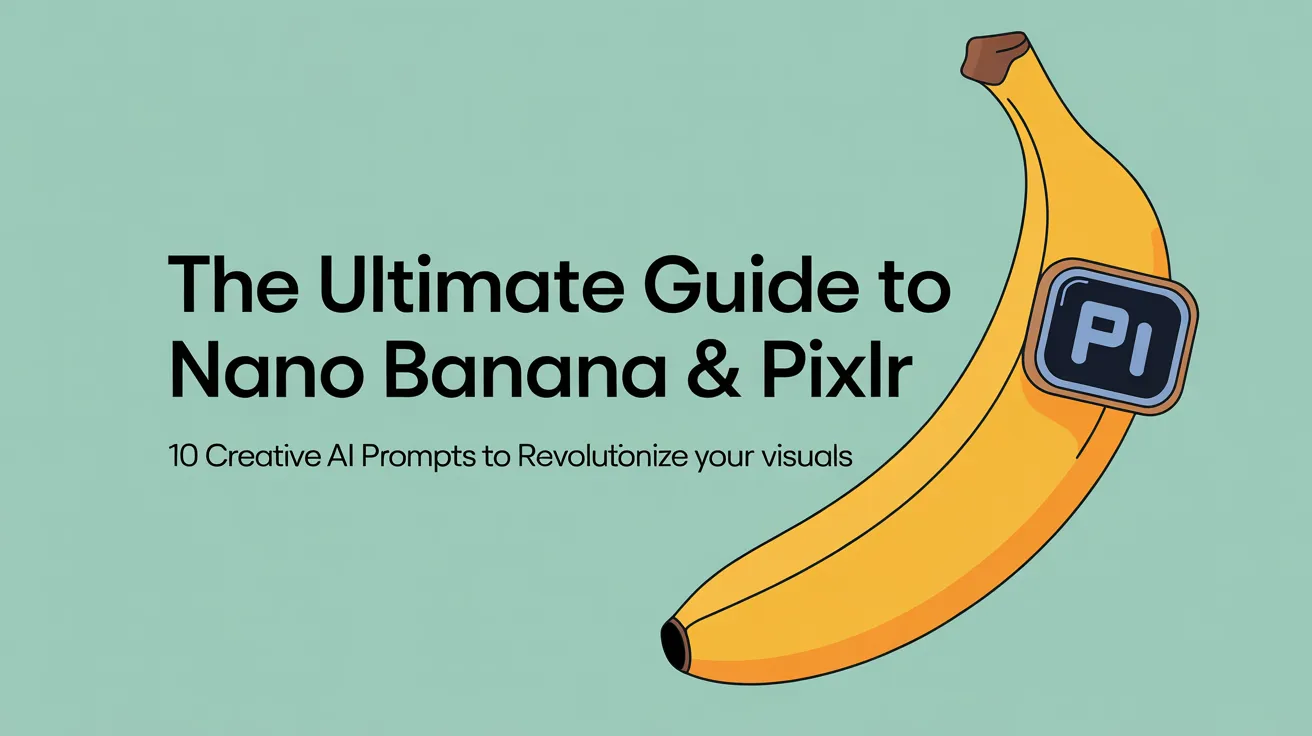
Nano Banana Pixlr AI Prompts Guide: Unlocking Creative Potential
Introduction: Understanding Nano Banana Pixlr AI Prompts
At its core, Nano Banana Pixlr AI prompts are structured input instructions that guide AI in creating images, graphics, and visual effects with remarkable precision. These prompts allow users—from beginners to professional designers—to achieve highly customized outputs without extensive manual editing.
The importance of understanding and mastering these prompts cannot be overstated. In a digital world saturated with content, the ability to create distinctive, high-quality visuals quickly gives creators a competitive edge. AI prompts act as both a creative catalyst and a productivity enhancer, reducing the time spent on repetitive tasks while expanding the possibilities of design.
Key Takeaways:
- Nano Banana Pixlr AI prompts optimize AI-assisted image creation.
- They provide structured guidance for achieving specific visual outcomes.
- Useful for both novice and expert designers aiming to enhance productivity and creativity.
Why Nano Banana Pixlr AI Prompts Matter Today
Digital visuals are the lifeblood of online engagement. From social media to advertising, compelling imagery captures attention and communicates messages more effectively than text alone. Nano Banana Pixlr AI prompts empower creators to produce high-quality, unique visuals that stand out in crowded digital spaces.
The relevance of these prompts today is multi-faceted:
- Speed and Efficiency: Instead of manually designing every element, AI interprets prompts to generate intricate visuals almost instantly.
- Consistency Across Projects: Prompts can be reused or modified, ensuring consistent style and tone across multiple assets.
- Creative Exploration: AI-driven prompts allow experimentation with styles, color palettes, and compositions that might be difficult to achieve manually.
For businesses and individual creators alike, this means faster content production, higher visual quality, and the ability to adapt quickly to changing design trends. According to Adobe’s insights on AI in design, integrating AI tools into creative workflows enhances both productivity and innovation.
Key Takeaways:
- AI prompts significantly reduce the time needed for high-quality content creation.
- They enable creative experimentation that may not be feasible manually.
- Reusable prompts ensure brand consistency and visual coherence.
Key Benefits and Insights
Nano Banana Pixlr AI prompts are more than just convenience tools—they offer strategic advantages for anyone involved in digital design.
Enhanced Creativity
AI interprets prompts in ways that can spark new ideas. A simple instruction like “vibrant abstract banana pattern” can produce unexpected compositions, textures, and color harmonies.
Precision and Control
Creators can dictate details such as style, mood, color schemes, and composition, giving them control over the AI’s output. This allows for both experimentation and precision.
Accessibility
Even those without advanced design skills can generate professional-looking graphics. Nano Banana Pixlr AI prompts lower the barrier to entry for digital design.
Scalability
Businesses can scale visual content production without significantly increasing resources. AI handles repetitive or complex tasks efficiently.
Key Takeaways:
- AI prompts foster both creativity and precision.
- They make professional-grade design accessible to a wider audience.
- They are ideal for scaling content production efficiently.
Practical Application: How to Use Nano Banana Pixlr AI Prompts
Using Nano Banana Pixlr AI prompts effectively involves a combination of thoughtful planning, experimentation, and iterative refinement.
Step-by-Step Guide
- Define Your Goal: Determine the purpose of your visual. Are you creating social media graphics, website visuals, or product mockups?
- Craft the Prompt: Be specific. Include details like color, style, mood, and elements. Example: “Surreal banana floating in cosmic space, vibrant neon colors, 4k resolution.”
- Input the Prompt into Pixlr AI: Use the AI image generation tool and enter your prompt.
- Refine Output: Evaluate the result and adjust the prompt as needed. Add or remove descriptors to align with your vision.
- Download and Edit: Once satisfied, download the image and apply any post-processing touches if required.
Tips for Effective Prompts
- Use Adjectives and Style References: Terms like “minimalist”, “vintage”, or “futuristic” guide AI toward desired aesthetics.
- Specify Composition: Include instructions like “close-up”, “wide-angle”, or “top-down view”.
- Iterate: AI outputs improve with iterative feedback—refine your prompts to hone the final image.
Key Takeaways:
- Clear, detailed prompts yield better AI-generated visuals.
- Iterative refinement is crucial for achieving desired results.
- Combining AI generation with manual editing can enhance overall quality.
Real-Life Use Cases and Examples
Marketing and Social Media
Brands use AI-generated images to create eye-catching social media posts, promotional banners, and product visuals. For instance, a smoothie company could generate a surreal “nano banana” visual to create viral marketing content.
E-Commerce and Product Design
AI prompts can quickly produce variations of product images, mockups, and packaging designs. This accelerates the design process and facilitates rapid A/B testing.
Art and Creative Projects
Artists leverage Nano Banana Pixlr AI prompts to experiment with unconventional styles, merge concepts, or visualize ideas that would be challenging manually.
Educational and Training Materials
Teachers and content creators can generate visuals for presentations, infographics, and instructional materials, enhancing engagement and comprehension.
Key Takeaways:
- AI-generated visuals have applications across marketing, design, art, and education.
- They support experimentation and innovation in creative projects.
- The versatility of prompts allows customization for diverse audiences and purposes.
Expert Tips and Best Practices
- Start Simple, Then Layer Complexity: Begin with basic prompts and gradually add more descriptors.
- Reference Styles or Artists: Mentioning specific styles (e.g., “inspired by Van Gogh”) guides AI toward recognizable aesthetics.
- Use Negative Prompts: Indicate what you don’t want in the image to reduce unwanted elements.
- Leverage Prompt Libraries: Communities often share effective prompts that can be adapted for your projects.
- Keep Experimenting: AI creativity is non-linear; unexpected results can inspire new directions.
Common Challenges and How to Overcome Them
- Ambiguous Results: Sometimes AI outputs do not match expectations. Overcome this by making prompts more precise.
- Repetitive Outputs: AI may generate similar patterns repeatedly. Introduce variation in descriptors or styles.
- Overcomplication: Including too many details can confuse the AI. Focus on essential elements first.
- Color or Style Mismatch: Use references to ensure consistent visual style.
Key Takeaways:
- Clarity and specificity in prompts reduce misalignment.
- Iteration and variation enhance originality and output quality.
Comparisons and Alternatives
While Nano Banana Pixlr AI prompts excel in creative image generation, alternatives exist for various needs:
- DALL·E: Offers versatile AI image generation with highly detailed prompts.
- MidJourney: Focuses on artistic and surreal visuals with deep style controls.
- Canva AI: Simplified AI integration for marketing and social media graphics.
Each platform has its strengths. Pixlr AI stands out for ease of integration with editing tools and prompt-based precision.
Key Takeaways:
- Choice of AI platform depends on project goals.
- Pixlr AI excels for prompt-driven creative and practical design workflows.
Future Perspective of AI-Driven Visuals
AI-driven image creation is poised to become more intuitive, adaptive, and integrated into daily creative workflows. Expect:
- Smarter Prompt Interpretation: AI understanding will improve, reducing the need for overly detailed instructions.
- Seamless Integration: AI-generated images will merge effortlessly with traditional editing tools.
- Personalized Creativity: AI will learn individual preferences, offering suggestions tailored to each creator.
- Collaborative Design: Teams will collaborate in real-time with AI generating variations and refinements.
Key Takeaways:
- AI tools like Pixlr are shaping the future of digital creativity.
- Continuous learning and adaptation will make AI a standard collaborator in creative workflows.
FAQ: Nano Banana Pixlr AI Prompts
What are Nano Banana Pixlr AI prompts, and how do they work?
Nano Banana Pixlr AI prompts are structured instructions used to guide AI image generation within Pixlr. These prompts work by defining the visual elements, style, and composition desired in the final output. When inputted, the AI interprets the keywords, adjectives, and descriptors to produce images that match the user’s vision. For example, a prompt such as “surreal banana in a neon cyberpunk city, cinematic lighting” instructs the AI to combine specific subject matter (banana), style (surreal, cyberpunk), and visual tone (cinematic lighting). This approach enables both precision and creativity, allowing users to experiment with unconventional ideas that might be challenging to produce manually. The prompts are highly flexible; users can iterate on them by adding details, removing elements, or modifying styles. This iterative process enhances control over the final output while leveraging AI’s creative algorithms to explore new visual possibilities. Additionally, Nano Banana Pixlr AI prompts are accessible to both novice users and professional designers, making high-quality design achievable without extensive technical skills. By understanding the structure and logic of prompts, creators can maximize the AI’s potential, producing visuals that are both innovative and aligned with their creative goals.
How can beginners effectively use Nano Banana Pixlr AI prompts?
Beginners can effectively use Nano Banana Pixlr AI prompts by following a structured approach. First, start by clearly defining the purpose of the visual—whether it’s for social media, a blog, or an artistic project. Next, craft simple prompts that focus on the main subject and basic style. For instance, a beginner might use “banana in a minimalist abstract background” to get a clean, focused image. Once the initial output is generated, examine it critically and note what could be improved, such as composition, color, or lighting. Then, modify the prompt by adding adjectives, specifying styles, or including composition instructions like “top-down view” or “close-up shot.” Iteration is key; each refinement helps the AI produce outputs closer to your vision. Beginners should also explore prompt libraries or communities for inspiration and examples, which can be adapted for their own projects. Additionally, leveraging Pixlr’s built-in editing tools to adjust AI-generated images can enhance results without requiring advanced design skills. By combining thoughtful prompt creation with iterative refinement and basic post-processing, beginners can rapidly achieve professional-quality visuals while building confidence and skill in AI-driven design.
What are common mistakes to avoid when crafting AI prompts in Pixlr?
Common mistakes when crafting AI prompts in Pixlr include vagueness, overcomplication, and lack of iteration. Vague prompts, such as “banana image,” often lead to outputs that are generic or unrelated to your intended style. Overcomplication is another pitfall; including too many details can confuse the AI and produce cluttered results. It’s better to prioritize key elements and gradually layer additional instructions. Ignoring iterative refinement is also a mistake; initial outputs rarely match expectations, and modifying prompts is essential for precision. Additionally, failing to use style references or negative prompts can lead to mismatched aesthetics or undesired elements in the image. Beginners may also overlook the importance of composition and color specifications, resulting in visuals that lack balance or coherence. To avoid these mistakes, start with clear, concise prompts, focus on essential elements, and experiment with adjustments. Utilize examples from prompt libraries or community-shared prompts to understand what works effectively. Finally, always review outputs critically and make incremental changes, leveraging AI’s strengths while maintaining creative control. This approach ensures higher quality, consistent, and visually appealing results.
Can Nano Banana Pixlr AI prompts be used for professional marketing campaigns?
Absolutely, Nano Banana Pixlr AI prompts are highly suitable for professional marketing campaigns. They enable brands to generate eye-catching visuals quickly, maintain stylistic consistency, and experiment with creative concepts that resonate with audiences. For instance, a brand promoting a tropical smoothie line can use prompts like “glowing banana in a vibrant tropical setting with cinematic lighting” to produce striking imagery for social media or advertisements. AI-generated visuals can also be adapted for email campaigns, website banners, and product packaging, ensuring cohesive branding. The ability to iterate prompts means marketers can rapidly test multiple variations, enhancing engagement through A/B testing. However, it’s crucial to review outputs carefully to ensure brand alignment and originality. Combining AI-generated content with human oversight ensures that the visuals meet professional standards and comply with advertising regulations. By integrating Nano Banana Pixlr AI prompts into marketing workflows, brands can save time, increase creativity, and produce high-quality visuals that captivate their target audience while maintaining a consistent brand identity.
How do Nano Banana Pixlr AI prompts compare to other AI image generators?
Nano Banana Pixlr AI prompts offer several advantages compared to other AI image generators, particularly in terms of integration with editing tools, flexibility, and ease of use. While platforms like DALL·E or MidJourney specialize in high-detail or surreal artistic visuals, Pixlr AI excels in providing prompt-driven outputs that are immediately editable within the same interface. This seamless workflow allows users to generate, refine, and post-process images without switching platforms. Additionally, Pixlr AI’s prompts provide precise control over style, composition, and color, making them suitable for practical applications like marketing, product visuals, and social media content. The accessibility of Pixlr AI also sets it apart; users with minimal design experience can quickly create professional-grade images. However, for highly experimental or ultra-realistic visuals, other AI generators may offer more stylistic diversity. Ultimately, the choice depends on project goals, desired control level, and integration needs. Nano Banana Pixlr AI prompts shine in scenarios requiring a balance of creativity, practicality, and editing flexibility, offering a unique advantage in professional and personal design workflows.
What is the future potential of AI prompts in digital creativity?
The future potential of AI prompts in digital creativity is vast and transformative. As AI continues to evolve, prompt-based image generation will become more intuitive, personalized, and seamlessly integrated into creative workflows. We can expect smarter AI capable of interpreting natural language with minimal instructions, reducing the need for complex prompt engineering. Personalized AI assistants may learn a creator’s style preferences over time, offering suggestions that align closely with individual aesthetic sensibilities. Integration with collaborative tools will enable teams to co-create in real-time, with AI generating multiple variations and refinements instantly. Moreover, AI prompts will expand beyond image generation into multimedia, including video, animation, and interactive designs. Ethical considerations and originality verification will also become integral, ensuring AI enhances creativity without compromising authenticity. For creators, mastering AI prompts early offers a strategic advantage, positioning them at the forefront of a creative revolution where human imagination and machine intelligence converge to unlock unprecedented possibilities in digital art and content production.
Conclusion
Nano Banana Pixlr AI prompts represent a fusion of creativity and technology, empowering creators to produce high-quality, unique visuals efficiently. From beginners exploring AI-assisted design to professionals optimizing marketing campaigns, these prompts provide both precision and creative freedom. By mastering prompt crafting, iterative refinement, and post-processing integration, users can unlock the full potential of AI-driven imagery.
As the digital landscape becomes increasingly competitive, leveraging tools like Pixlr AI ensures faster production, consistency, and innovation. The future of visual content creation is collaborative, adaptive, and AI-enhanced—making Nano Banana Pixlr AI prompts a vital skill for any modern digital creator.
Recent Posts
Why Your Blog Gets Traffic But No Clicks (3X Your CTR Fast)
You check Google Analytics. The numbers look solid—thousands of impressions, steady organic traffic rolling in. But then you see the ugly truth: your click-through rate is hovering at 1.2%, and your phone isn’t ringing with leads. Sound familiar? This is the silent killer of blogging success. You’re winning the visibility battle but losing the engagement...
Read More
Top AI Side Hustles That Require Zero Investment: The Complete Beginner’s Guide
The landscape of earning money online has fundamentally shifted. What once required expensive software, years of training, or significant startup capital can now be accomplished with nothing more than a laptop, an internet connection, and free artificial intelligence tools. The barrier to entry hasn’t just been lowered—it has been demolished. Whether you are a student...
Read More
Unlock the Power of AI: How Beginners Are Making $500/Month with AI Tools
Last year, I was stuck in the same cycle most people face when trying to earn extra income online. I spent hours creating content, designing graphics, or handling repetitive tasks, only to see minimal returns. Then I started experimenting with AI tools—not as a magic button, but as smart assistants that multiply effort. Over several...
Read More