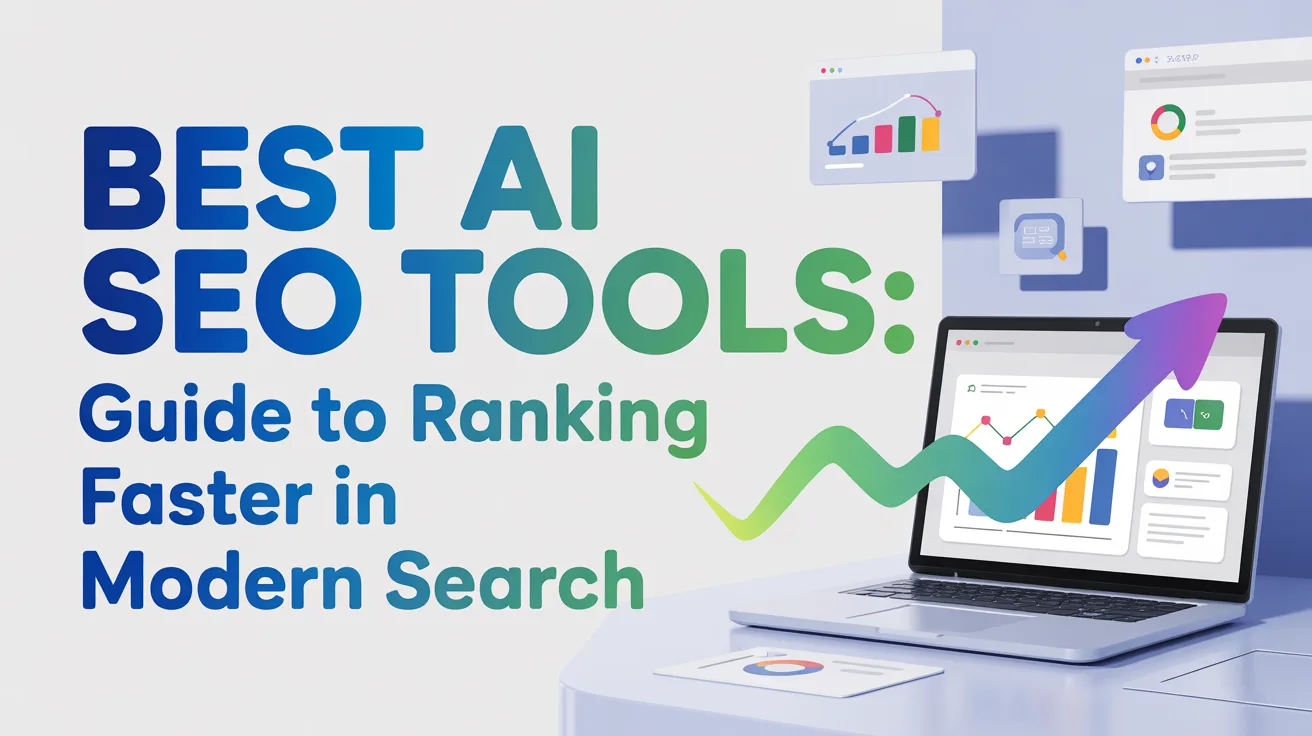
Best AI SEO Tools: The Ultimate Guide to Ranking Faster in Modern Search
For almost two decades, the rules of the game were simple: find a keyword, build backlinks, and climb the ten blue links. That era is officially over.
We have entered the age of the Answer Engine. Search is no longer just about navigating to a website; it is about getting an instant, synthesized answer. Whether users are querying ChatGPT, Perplexity, Google’s AI Overviews, or Claude, the battleground has shifted from ranking positions to citations.
If your content isn’t structured for machine retrieval and optimized for generative engines, you are invisible—even if you rank #1 for a keyword. Based on current data regarding the shift toward “Agentic Traffic” and zero-click environments, this guide analyzes the specific technologies required to keep your traffic thriving .
Here is your expert blueprint for the best AI SEO tools, categorized by how they actually automate the modern pipeline.
What is AI SEO (and Why Machine-First Optimization Matters)
Traditional SEO optimized for a crawler (Googlebot). AI SEO optimizes for a Large Language Model (LLM) . The difference is profound.
When a user asks an AI “What is the best project management software?” the LLM does not simply list the top 10 URLs. It scrapes hundreds of sources, evaluates extractability, checks verifiability, and synthesizes a specific answer. If your content is buried behind fluff, missing structured data, or lacks clear definitions, the AI will ignore you.
AI SEO is the practice of engineering your content so that LLMs view your brand as the definitive source for a specific entity. It merges traditional technical SEO with Generative Engine Optimization (GEO) .
The Shift: From Click-Through Rates to Citation Rates
We are seeing a structural transformation where discovery is driven by synthesized answers. The goal is no longer just the click; it is to be the cited source within the answer.If an AI Overview cites your data, you capture “mind share” even if the user never visits your site, which ultimately drives branded follow-up searches — a trend Forbes analyzed in depth regarding zero-click search behavior.
Key Benefits of Adopting AI-Native SEO Tools
Why should you invest in a tech stack built for this new landscape?
- Visibility in Zero-Click Environments: Over 60% of searches now end without a click. AI SEO tools optimize your content so that your brand appears inside the AI’s summary, capturing traffic before the “click” is lost .
- Entity Extraction: Modern tools ensure that Google and LLMs correctly identify your brand’s “Knowledge Graph” associations (e.g., ensuring the AI knows “Company X” is the expert in “cybersecurity”).
- Automation of the “Brain Drain”: A human can research a topic for three days. AI agents can do it in three minutes, scraping SERPs and competitor gaps instantly.
How to Apply AI for Dominant Rankings (The 4 Pillars)
To effectively use these tools, you must restructure your workflow. Based on recent automation frameworks, here is the optimal pipeline :
1. The Research Phase (Entity & Gap Analysis)
Forget simple keyword density. You need topical authority maps.
- Action: Use tools to analyze the “Top 20” SERP results, not just the top 3.
- Tech Requirement: Look for tools that extract “People Also Ask” questions and semantic entities (NLP).
2. The Strategy Phase (Brief Creation)
Most content fails because the brief is a hunch.
- Action: Generate data-driven outlines that include word count benchmarks, heading structure, and internal linking suggestions based on competitor data.
3. The Writing Phase (GEO & E-E-A-T)
The AI writer must write for the machine first, humans second.
- Action: Use Generative Engine Optimization scoring to ensure facts are verifiable and definitions are explicit. Content must be written in a “Question & Answer” format to trigger voice and AI results .
4. The Monitoring Phase (Agentic Traffic)
Standard analytics often miscategorize traffic from AI crawlers (GPTBot, ClaudeBot) as “Direct” traffic.
- Action: You need specialized visibility dashboards that track citations across platforms like Gemini and Perplexity specifically.
Common Use Cases and Real-Life Examples
Case Study: The Cybersecurity SaaS Shift
A B2B cybersecurity company realized that their C-suite buyers were asking ChatGPT “What are the top threats in 202X?” instead of Googling. Their traditional blog posts weren’t being cited.
- The Fix: They implemented an AI Visibility Tracking tool and restructured their content using a “Definition/FAQ” schema .
- The Result: Within 90 days, they saw a 60% increase in AI visibility scores and became the cited authority for threat intelligence queries .
Use Case: E-commerce Product Pages
An e-commerce site sells “Noise-canceling headphones.” An AI search for “best headphones for airplanes” synthesizes data from Reddit, review sites, and manufacturer specs.
- The Tool: They used structured data tools (Product and Review schema) and sentiment analysis to ensure the AI recognized their high review scores.
- The Outcome: Even though their product page rank was #5 on Google, they were the #1 cited source in Google’s AI Overview for their category.
Expert Tips and Best Practices for 2026
Drawing from current data on how AI models like Google’s Gemini and ChatGPT parse content , here are the non-negotiables:
1. Optimize for “Chunking”
LLMs do not read your page like a novel; they cut it into “chunks.” Every subheading (H2/H3) must be a self-contained answer.
Bad: “Our History” -> Good: “Why Our Company Was Founded in 2005 (The Mission)”
2. Prioritize Verifiability
AI models suffer from hallucinations. If you include statistics, link to the primary source (e.g., “According to Forbes Study…”).
- Tech Tip: Use Schema markup for
ClaimandQuotationto help the AI verify facts.
3. The llms.txt Protocol
Just as you had robots.txt for crawlers, you need an llms.txt file to guide AI agents. This plain text file tells the AI exactly where to find the definitive answer to a specific question on your site .
4. Don’t Kill Your SEO for GEO
Be wary of “bad advice” that suggests creating a second, “AI-only” copy of your site. This creates duplicate content issues. Focus on improving the readability and structure of your main domain.
Challenges and How to Overcome Them
Challenge 1: The “Black Box” Problem
You can see Google rankings, but how do you know if ChatGPT is citing you?
- Solution: Invest in AI Visibility Dashboards. Tools like SE Visible and Frase Watchdog actively query LLMs to see if your brand appears. They provide an “AI Share of Voice” metric. You cannot optimize what you cannot measure .
Challenge 2: On-Device LLMs (Apple Intelligence)
New hardware runs models locally. If the user asks Siri a question while offline, your server logs won’t capture that “query.”
- Solution: Optimize for contextual clarity and speed. On-device models prioritize lightweight, clear text over heavy, bloated JavaScript frameworks.
Challenge 3: The Hallucination Risk
The AI might invent a price for your product or claim you offer a feature you don’t.
- Solution: Use Agentic Monitoring tools that automatically detect misrepresentations. Some platforms now use an “Auto-Optimize” feature that rewrites content to correct factual drift in AI models .
Comparisons and Alternatives
When building your stack, you generally have two paths: The All-in-One Agent or The Modular Suite.
Option A: The Full-Stack AI Agent
Tools like Frase or SE Ranking aim to cover the entire pipeline from Research -> Write -> Monitor -> Fix.
- Best For: Content teams who want one login and automated workflows (e.g., “Fix this ranking drop automatically”).
- Key Tech: Read/Write MCP connections allowing AI to publish directly to your CMS .
Option B: The Specialized Suite (Semrush & Ahrefs)
Classic giants like Semrush and Ahrefs have pivoted hard. They offer immense depth in Competitive Intelligence and Backlink Analysis (things pure AI tools lack). However, their AI writing/optimization is often a module bolted onto a massive suite.
- Best For: Enterprise teams needing deep keyword data and backlink auditing alongside their AI writing .
| Feature | AI-First Agent (e.g., Frase/SE Ranking) | Traditional Suite (e.g., Semrush) |
|---|---|---|
| Primary Focus | Content Optimization & GEO | Backlinks & Technical Audits |
| Visibility Tracking | Tracks AI Platforms natively | Requires separate add-on |
| Workflow | Built for Writers & Creators | Built for Analysts & Managers |
| Automation Depth | High (Agentic Fixes) | Medium (Data-Driven Insights) |
FAQs About AI SEO Tools
Q1: Does traditional backlinking still matter for AI Search?
Yes, but indirectly. LLMs do not “count” links like Google’s PageRank. However, they do measure co-citation and entity authority. If reputable news sites (high E-E-A-T) link to you, the LLM learns that other trusted sources trust you. Therefore, digital PR is now a core AI ranking factor .
Q2: What is the difference between GEO and traditional SEO?
GEO (Generative Engine Optimization) focuses on being cited in a summarized answer, while traditional SEO focused on ranking a URL in a list of links. GEO prioritizes clarity and verifiability; SEO historically prioritized keywords and dwell time. You need both. Optimize for keywords to get crawled, optimize for structure to get cited .
Q3: How do I track traffic that comes from an AI agent (like AutoGPT)?
You cannot track it easily via standard Google Analytics because the agent visits the page without rendering JavaScript or sending a user-agent string you can easily filter. You need to set up server log analysis or use a dedicated AI Visibility platform that prompts the AI to ask specific questions to see if your URL is used in the response .
Q4: Do I need to use Schema Markup for AI?
Absolutely. While AI models can read text, JSON-LD (Structured Data) acts as a “cheat sheet.” It explicitly tells the AI: “This is the author’s name,” “This is the FAQ answer,” or “This is the price.” It removes the burden of inference from the model, drastically reducing hallucination risk.
Q5: What is an “SEO Agent” vs. an “AI Writer”?
An AI Writer (like basic ChatGPT) takes a prompt and outputs text. An SEO Agent is a tool that connects to live SERP data, analyzes competitors, writes the draft, scores it against the top 10 results, publishes it, and monitors it for decay. The agent does the job of an entire team. The distinction is automation depth .
Actionable Takeaways
To survive the shift from Search to Synthesis, implement these steps immediately:
- Audit your current “Chunking.” Look at your last blog post. If you removed the introduction, does an H2 make sense on its own? If not, rewrite it for the LLM.
- Set up AI Visibility Tracking. Find out if the AI engines are talking about you. If they aren’t, you are losing market share to competitors.
- Move beyond the “Blue Link.” Start measuring your Share of Voice on Perplexity and Google AI Overviews.
- Update your Technical SEO. Implement
llms.txtand ensure your structured data is flawless.
The tools have evolved past simple grammar checks. They are now automated agents capable of research, writing, and recovery. The winners in this new search landscape will not be the biggest brands, but the most structured ones.
Recent Posts
Best AI SEO Tools: The Ultimate Guide to Ranking Faster in Modern Search
For almost two decades, the rules of the game were simple: find a keyword, build backlinks, and climb the ten blue links. That era is officially over. We have entered the age of the Answer Engine. Search is no longer just about navigating to a website; it is about getting an instant, synthesized answer. Whether users...
Read More
15 AI Tools Making People Rich (No Code Needed)
15 AI Tools You Didn’t Know Are Making People Rich: The Ultimate Guide to Untapped Digital Goldmines Most people think they’ve missed the AI gold rush. They see the same headlines about ChatGPT and Midjourney and assume the window of opportunity has slammed shut. They couldn’t be more wrong. While the masses are fighting over...
Read More
Why Your Blog Gets Traffic But No Clicks (3X Your CTR Fast)
You check Google Analytics. The numbers look solid—thousands of impressions, steady organic traffic rolling in. But then you see the ugly truth: your click-through rate is hovering at 1.2%, and your phone isn’t ringing with leads. Sound familiar? This is the silent killer of blogging success. You’re winning the visibility battle but losing the engagement...
Read More
Top AI Side Hustles That Require Zero Investment: The Complete Beginner’s Guide
The landscape of earning money online has fundamentally shifted. What once required expensive software, years of training, or significant startup capital can now be accomplished with nothing more than a laptop, an internet connection, and free artificial intelligence tools. The barrier to entry hasn’t just been lowered—it has been demolished. Whether you are a student...
Read More
Unlock the Power of AI: How Beginners Are Making $500/Month with AI Tools
Last year, I was stuck in the same cycle most people face when trying to earn extra income online. I spent hours creating content, designing graphics, or handling repetitive tasks, only to see minimal returns. Then I started experimenting with AI tools—not as a magic button, but as smart assistants that multiply effort. Over several...
Read More
AI Tools That Replace Human Work: The Complete Reality Guide
Artificial intelligence has evolved from science fiction into a workplace reality that touches nearly every industry. While headlines scream about robots stealing jobs, the actual story is far more nuanced—and ultimately more hopeful for professionals willing to adapt. This comprehensive guide cuts through the hype to reveal what AI automation really means for your career,...
Read More