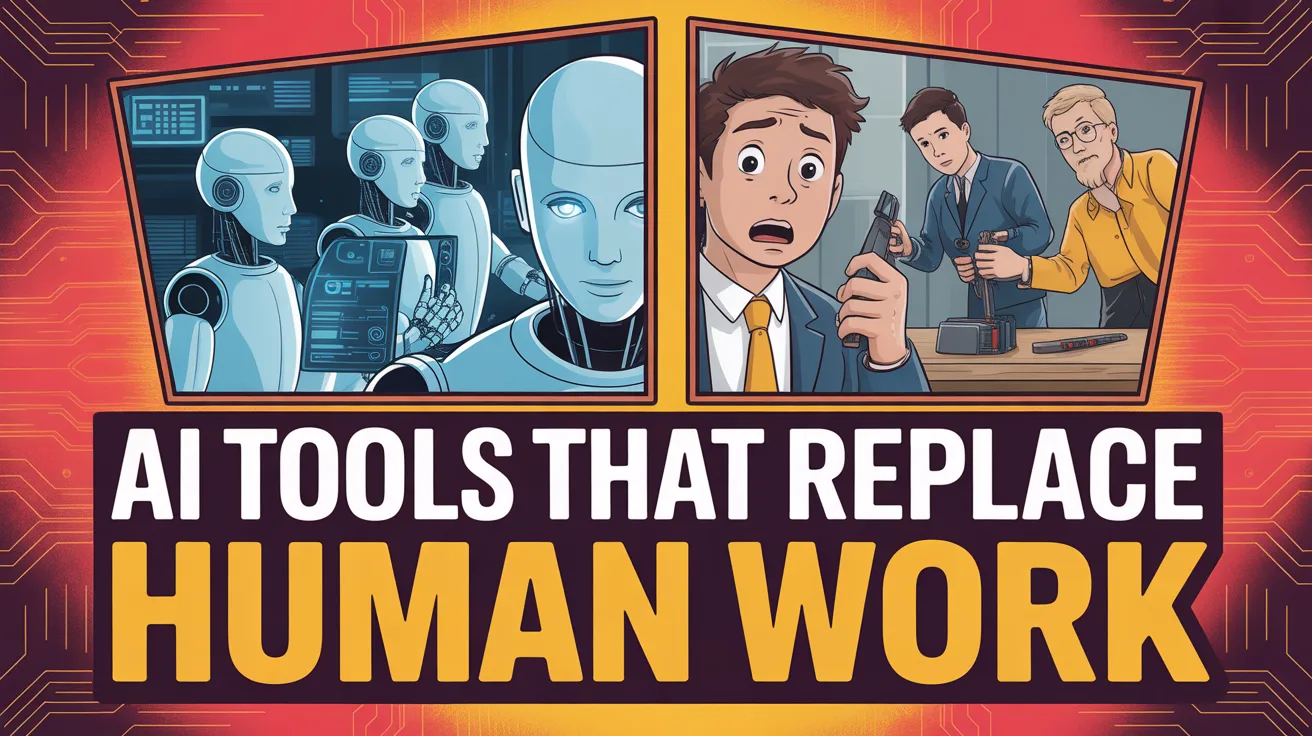
AI Tools That Replace Human Work: The Complete Reality Guide
Artificial intelligence has evolved from science fiction into a workplace reality that touches nearly every industry. While headlines scream about robots stealing jobs, the actual story is far more nuanced—and ultimately more hopeful for professionals willing to adapt. This comprehensive guide cuts through the hype to reveal what AI automation really means for your career, which tools are genuinely transforming industries, and how you can position yourself to thrive in an AI-augmented workplace.
Whether you’re a freelancer looking to boost productivity with AI tools, a developer exploring the best AI tools for coding, or a business owner wondering if AI will replace your team, this guide provides the expert insights you need to navigate the future of work confidently.
What Is AI Workplace Automation and Why It Matters
AI workplace automation refers to the use of artificial intelligence technologies—including machine learning, natural language processing, computer vision, and robotic process automation—to perform tasks that previously required human intelligence and effort. Unlike traditional automation that handled repetitive physical tasks, modern AI can write code, analyze legal documents, generate marketing copy, diagnose medical conditions, and even create art.
According to Goldman Sachs Research, AI investment is forecasted to approach $200 billion globally, with the U.S. positioned as the market leader in AI technology adoption. This massive investment signals that AI transformation isn’t a distant possibility—it’s happening now.
The Evolution from Simple Automation to Intelligent Agents
The automation landscape has shifted dramatically. We’ve moved from basic rule-based systems to sophisticated AI agents capable of autonomous decision-making. Gartner predicts that 40% of enterprise applications will feature task-specific AI agents by the end of 2026, up from less than 5% today.
Key Takeaways:
- AI automation now encompasses cognitive tasks, not just physical labor
- Investment levels indicate permanent structural changes to the workforce
- The shift from AI assistants to autonomous agents represents a fundamental technological leap
- Organizations adopting AI-first strategies will achieve 25% better business outcomes by 2028
Key Benefits and Insights of AI in the Workplace
Understanding the benefits of AI automation helps professionals identify opportunities rather than just threats. When implemented thoughtfully, AI creates value that extends beyond cost-cutting to enable entirely new capabilities.
Productivity Gains and Time Reclamation
The most immediate benefit of workplace AI is productivity enhancement. Research indicates that AI can help professionals reclaim 26% to 36% of their time in routine, content-heavy, and data-driven areas. This isn’t about working longer—it’s about focusing human creativity on high-value activities while AI handles repetitive cognitive tasks.
For content creators and marketers, tools like AI-powered SEO content writers can dramatically accelerate content production without sacrificing quality. Similarly, AI tools for YouTubers are transforming video production workflows.
Enhanced Decision-Making Capabilities
AI excels at processing vast datasets to identify patterns invisible to human analysts. In finance functions, 49% of organizations now use AI for knowledge management—helping teams organize, retrieve, and leverage information for better decision-making. Code generation has emerged as the highest-impact AI use case, enabling technical staff to find custom automation opportunities.
Democratization of Specialized Skills
Perhaps the most profound benefit is how AI democratizes access to specialized expertise. Small businesses can now access legal document analysis, financial forecasting, and marketing analytics that were previously available only to enterprises with massive budgets. This leveling of the playing field creates opportunities for AI side hustles that actually make money.
How to Use AI Tools Effectively in Your Workflow
Successfully integrating AI into your work requires more than just subscribing to the latest tools. It demands a strategic approach to human-AI collaboration.
Identify High-Impact Automation Opportunities
Start by auditing your daily tasks using the “DEAL” framework:
- Delete tasks that AI makes unnecessary
- Evaluate which tasks AI can handle entirely
- Augment your capabilities with AI assistance
- Leverage AI for tasks beyond human scale
Build AI Literacy Across Your Organization
Only 28% of employees currently know how to use their company’s AI applications effectively. This skills gap represents both a challenge and an opportunity. Organizations that invest in AI training and create centers of excellence capture significantly more value from their technology investments.
For freelancers and solopreneurs, developing AI proficiency can be the difference between thriving and becoming obsolete. Explore free AI tools every freelancer should use to start building your capabilities without massive investment.
Maintain Human Oversight and Creativity
The most effective AI implementations treat the technology as a collaborative partner, not a replacement. Human judgment remains essential for ethical considerations, creative direction, complex problem-solving, and relationship building. The goal is augmentation, not replacement.
Real-Life Use Cases and Examples
Concrete examples illustrate how AI is actually being deployed across industries today. These aren’t futuristic scenarios—they’re happening right now.
Content Creation and Digital Marketing
AI content tools have matured beyond simple text generation. Modern systems can research topics, optimize for search engines, generate images, create video scripts, and personalize content at scale. However, the most successful content strategies combine AI efficiency with human creativity and strategic oversight.
If you’re comparing AI writing assistants, check out our detailed analysis of ChatGPT vs DeepSeek to choose the right tool for your needs.
Software Development and Engineering
AI coding assistants have become indispensable for many developers. These tools don’t just autocomplete code—they can explain complex algorithms, debug errors, suggest optimizations, and even generate entire functions from natural language descriptions. The result isn’t fewer developers; it’s developers who ship better code faster.
For developers looking to maximize their AI tooling, our guide on the best AI tools for developers provides specific recommendations.
Customer Service and Support
AI-powered chatbots and virtual assistants now handle routine customer inquiries 24/7, escalating complex issues to human agents. This hybrid approach improves response times while ensuring customers receive human attention when empathy and complex problem-solving are required.
Financial Analysis and Accounting
In finance functions, AI adoption has reached 59% of organizations, with applications including accounts payable automation (37% adoption), error detection (34%), and predictive analytics. These tools reduce manual data entry while improving accuracy and compliance.
Healthcare Diagnostics and Research
Medical AI systems can now analyze imaging scans, predict patient deterioration, and accelerate drug discovery. However, these tools augment rather than replace physicians, providing decision support that improves diagnostic accuracy and patient outcomes.
Expert Tips and Best Practices
Industry leaders who have successfully navigated AI transformation share these recommendations for maximizing value while minimizing disruption.
Start with Pilot Projects
Rather than attempting enterprise-wide transformation immediately, identify specific use cases where AI can deliver measurable results within 90 days. This approach builds organizational confidence and generates the data needed to justify broader investments.
Focus on Data Quality
AI systems are only as good as the data they learn from. Organizations that invest in data cleaning, governance, and management see significantly better AI performance. According to industry research, inadequate data quality remains one of the largest obstacles to AI adoption.
Develop Hybrid Skill Sets
The most valuable professionals in the AI era combine domain expertise with AI fluency. A marketer who understands AI content tools, a lawyer who can leverage legal AI platforms, or a designer who works with generative AI has a significant competitive advantage.
For those looking to build passive income with AI tools, developing these hybrid capabilities is essential.
Monitor for Bias and Hallucinations
AI systems can perpetuate biases present in their training data and occasionally generate plausible-sounding but incorrect information. Implement human review processes, especially for high-stakes decisions, and maintain healthy skepticism about AI outputs.
Challenges and How to Overcome Them
AI adoption isn’t without obstacles. Understanding these challenges—and having strategies to address them—separates successful implementations from failed experiments.
The Skills Gap and Training Requirements
With enterprises running an average of 200 AI tools, employees often struggle to translate new capabilities into meaningful outcomes. The solution is structured training programs, clear documentation, and creating internal communities of practice where employees share AI use cases and best practices.
Cultural Resistance and Fear of Job Loss
When employees fear AI will eliminate their positions, they resist adoption. Leaders must communicate transparently about how AI will change roles rather than eliminate them, and invest in reskilling programs that prepare employees for AI-augmented work.
Integration with Existing Systems
Many organizations struggle to integrate AI tools with legacy systems and workflows. The solution often involves starting with standalone AI applications that don’t require deep integration, then gradually building more sophisticated connections as capabilities mature.
Measuring ROI and Business Value
Determining whether AI investments pay off can be challenging. Beyond cost savings, track metrics like employee time reclaimed, quality improvements, revenue from AI-enabled products, and customer satisfaction scores. Organizations with clear AI strategies are better positioned to realize full potential from their investments.
Comparisons: AI vs. Human Capabilities
Understanding what AI does well—and where humans remain essential—helps organizations design optimal workflows.Table
| Capability | AI Strengths | Human Strengths |
|---|---|---|
| Data Processing | Analyzing massive datasets, identifying patterns, generating reports | Interpreting context, understanding nuance, ethical judgment |
| Content Creation | Generating drafts, optimizing for SEO, personalizing at scale | Original creativity, emotional resonance, brand voice consistency |
| Customer Interaction | Handling routine inquiries 24/7, processing transactions | Complex problem-solving, empathy, relationship building |
| Decision Making | Scenario modeling, risk assessment, predictive analytics | Strategic vision, values-based choices, ambiguous situations |
| Innovation | Combining existing ideas in novel ways, rapid iteration | Breakthrough creativity, understanding unarticulated needs |
The future belongs to organizations that strategically combine these complementary strengths.
FAQs: Your Questions About AI and Jobs Answered
Will AI completely replace human workers?
No. While AI will displace some jobs, it will also create new roles and transform existing ones. Goldman Sachs Research suggests that innovation related to artificial intelligence could displace 6-7% of the US workforce if AI is widely adopted, but the impact is likely to be transitory as new job opportunities created by the technology ultimately put people to work in other capacities. History shows that technological revolutions typically create more jobs than they destroy, though the transition can be painful for displaced workers.
Which jobs are most at risk of AI automation?
Roles involving routine cognitive tasks—data entry, basic analysis, standardized customer service, and repetitive administrative work—face the highest automation risk. However, jobs requiring creativity, emotional intelligence, complex interpersonal skills, and physical dexterity in unpredictable environments remain relatively safe. The key is to develop skills that complement AI rather than compete with it.
How can I make my career AI-proof?
Focus on developing uniquely human capabilities: creative problem-solving, emotional intelligence, strategic thinking, and complex communication. Additionally, become the person who knows how to leverage AI effectively. The most secure professionals will be those who can orchestrate AI tools to deliver outcomes neither humans nor AI could achieve alone. Consider exploring AI automation for freelancers to future-proof your independent career.
What industries will be most transformed by AI?
Software and technology, financial services, healthcare, marketing and advertising, legal services, and customer service are experiencing the most immediate transformation. However, no industry will remain untouched. Even traditionally manual sectors like agriculture, construction, and manufacturing are seeing AI-driven improvements in efficiency and safety.
How long do I have to adapt to AI in the workplace?
The transformation is already underway, but you haven’t missed the window. Gartner predicts that by 2028, a third of user experiences will shift from native applications to agentic front ends. The next three to five years represent a critical adaptation period. Professionals who begin developing AI literacy now will have significant advantages over those who wait.
Is AI adoption worth the investment for small businesses?
Yes, but start strategically. Small businesses can access enterprise-grade AI capabilities through affordable SaaS tools, leveling the playing field with larger competitors. Begin with high-impact, low-cost applications like AI content writing, customer service chatbots, or accounting automation. As you realize returns, reinvest in more sophisticated tools. The key is starting now rather than waiting for perfection.
Key Takeaways
- AI is augmenting, not replacing: The most successful professionals will be those who learn to work alongside AI, leveraging its strengths while contributing uniquely human capabilities.
- The window for adaptation is open: While AI adoption is accelerating, there’s still time to develop the skills and strategies needed to thrive in an AI-augmented workplace.
- Focus on hybrid value: Combine domain expertise with AI fluency to create value that neither humans nor AI could deliver independently.
- Start small, think big: Begin with pilot projects that deliver measurable results, then scale based on proven success rather than hype.
- Invest in continuous learning: The AI landscape evolves rapidly. Commit to ongoing education and experimentation to stay ahead of the curve.
- Human skills matter more than ever: As AI handles routine cognitive tasks, creativity, emotional intelligence, and complex problem-solving become more valuable differentiators.
Conclusion
The reality of AI in the workplace is neither the utopian vision of effortless productivity nor the dystopian nightmare of mass unemployment. It’s a tool—extraordinarily powerful, undoubtedly disruptive, and ultimately neutral in its impact on human flourishing. What matters is how we choose to use it.
Organizations and individuals who approach AI strategically, invest in human capital alongside technology, and maintain focus on creating genuine value will thrive. Those who ignore the transformation or resist it out of fear will find themselves increasingly marginalized.
The question isn’t whether AI will change your work—it’s whether you’ll be ready to leverage that change to build a more fulfilling, productive, and secure career. Start today by exploring AI business ideas that align with your skills and interests, and take the first step toward becoming an AI-enabled professional.
Recent Posts

Why Your Blog Gets Traffic But No Clicks (3X Your CTR Fast)
You check Google Analytics. The numbers look solid—thousands of impressions, steady organic traffic rolling in. But then you see the ugly truth: your click-through rate is hovering at 1.2%, and your phone isn’t ringing with leads. Sound familiar? This is the silent killer of blogging success. You’re winning the visibility battle but losing the engagement...
Read More
Top AI Side Hustles That Require Zero Investment: The Complete Beginner’s Guide
The landscape of earning money online has fundamentally shifted. What once required expensive software, years of training, or significant startup capital can now be accomplished with nothing more than a laptop, an internet connection, and free artificial intelligence tools. The barrier to entry hasn’t just been lowered—it has been demolished. Whether you are a student...
Read More
Unlock the Power of AI: How Beginners Are Making $500/Month with AI Tools
Last year, I was stuck in the same cycle most people face when trying to earn extra income online. I spent hours creating content, designing graphics, or handling repetitive tasks, only to see minimal returns. Then I started experimenting with AI tools—not as a magic button, but as smart assistants that multiply effort. Over several...
Read More
AI Tools That Replace Human Work: The Complete Reality Guide
Artificial intelligence has evolved from science fiction into a workplace reality that touches nearly every industry. While headlines scream about robots stealing jobs, the actual story is far more nuanced—and ultimately more hopeful for professionals willing to adapt. This comprehensive guide cuts through the hype to reveal what AI automation really means for your career,...
Read More
How to Rank Blog Posts on Google Without Backlinks: The Definitive 2026 Guide
Ranking on Google without backlinks isn’t just possible in 2026—it’s become the preferred path to sustainable SEO success. As Google’s algorithms have evolved to prioritize E-E-A-T (Experience, Expertise, Authoritativeness, Trustworthiness) and topical authority over traditional link metrics, content creators who master these signals consistently outperform sites relying on outdated link-building tactics. The landscape has shifted...
Read More
How People Are Making Money with AI Content (Real Methods) | 2026 Guide
Artificial intelligence has fundamentally transformed content creation from a time-intensive craft into a scalable business asset. What once required teams of writers, designers, and video producers can now be accomplished by solopreneurs using intelligent tools. The shift isn’t just about speed—it’s about entirely new income models that didn’t exist a few years ago. This guide...
Read More