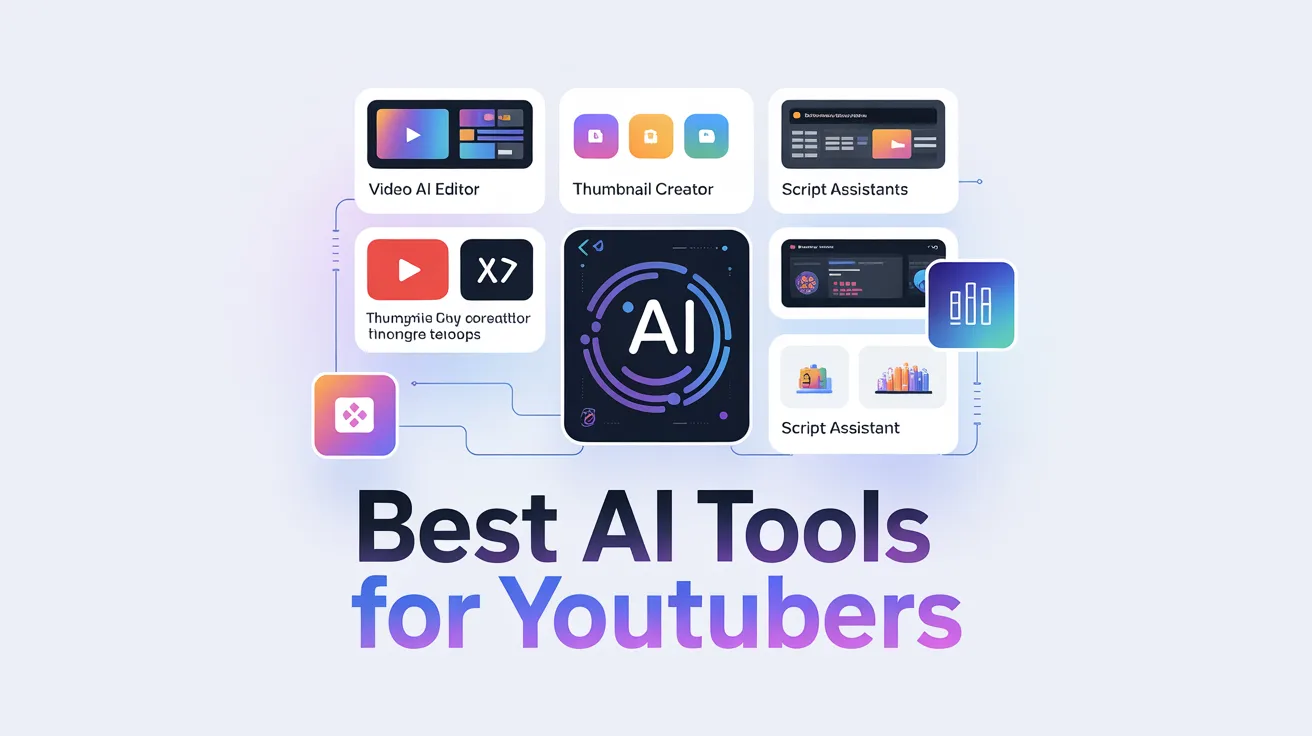
AI Tools for YouTubers: Complete Guide to Top Software
Creating professional YouTube content used to require expensive equipment, technical expertise, and countless hours of editing. Today, artificial intelligence has democratized video production, allowing creators of all skill levels to produce studio-quality content with minimal resources. Whether you’re launching your first channel or scaling an established presence, the right AI tools can transform your workflow from tedious to efficient.
This comprehensive guide explores the essential AI tools every YouTuber should consider, from script generation and voiceovers to video editing and thumbnail optimization. You’ll discover how to leverage these technologies to create more content, reach wider audiences, and grow your channel faster than ever before.
What Are AI Tools for YouTubers and Why They Matter
AI tools for YouTubers are software applications that use machine learning algorithms to automate and enhance various aspects of video creation. These tools handle everything from generating video ideas and writing scripts to editing footage, creating voiceovers, and optimizing content for search visibility.
The importance of these tools cannot be overstated. YouTube’s algorithm favors consistent, high-quality content, but producing videos at scale traditionally required teams of editors, writers, and designers. AI levels the playing field, allowing solo creators to maintain professional standards while publishing frequently enough to satisfy platform demands.
According to recent industry analysis, creators using AI-powered tools report reducing their production time by up to 70% while simultaneously improving content quality
. This efficiency gain translates directly into competitive advantage—channels that publish consistently with optimized metadata outperform sporadic creators by significant margins.
The strategic value extends beyond mere efficiency. AI tools provide data-driven insights that human intuition alone cannot match. From identifying trending topics before they peak to analyzing competitor strategies, these platforms enable creators to make informed decisions about content direction rather than relying on guesswork.
Key Benefits of Using AI Tools for YouTube Content Creation
Dramatic Time Savings
Traditional video production involves multiple time-intensive stages: research, scripting, filming, editing, thumbnail creation, and optimization. AI tools compress these workflows dramatically. What once took days now takes hours. OpusClip can transform a single long-form video into twenty Shorts in minutes
, while ElevenLabs generates professional voiceovers without recording booth sessions
.
Cost Efficiency
Hiring voice actors, editors, and designers costs thousands monthly. AI alternatives provide comparable quality at fraction of the price. A complete creator stack—including script generation, voiceover, editing, and thumbnail design—can cost under $50 monthly, compared to thousands for human contractors
.
Consistency at Scale
Maintaining quality across dozens of videos monthly is nearly impossible for solo creators without automation. AI ensures every video meets baseline professional standards, from consistent audio quality to properly formatted thumbnails. This consistency builds audience trust and signals professionalism to the YouTube algorithm.
Data-Driven Content Strategy
Perhaps the most significant advantage is strategic intelligence. AI analysis tools examine millions of videos to identify what actually works in your niche—not what theoretically should work, but what demonstrably drives views and engagement. This eliminates the costly trial-and-error phase that sinks many promising channels.
Accessibility and Inclusion
AI-generated captions and translations make content accessible to hearing-impaired viewers and international audiences. ElevenLabs offers dubbing in 29 languages, allowing creators to reach global markets without re-recording content
. This accessibility expansion can multiply potential audience size exponentially.
How to Use AI Tools Effectively for YouTube Success
Building Your AI Tool Stack
Successful creators don’t use every available tool—they select complementary applications that cover their specific workflow gaps. The foundation of any effective stack begins with strategic intelligence tools that inform what content to create, followed by production tools that streamline creation.
For new creators with limited budgets, the essential stack includes:
- Strategic Intelligence: Tools for keyword research and competitor analysis
- Script Generation: AI writing assistants for structured, engaging scripts
- Video Editing: Software with AI-powered auto-captions and scene detection
- Thumbnail Design: Platforms with templates and AI background removal
- Voiceover: Text-to-speech for creators uncomfortable recording audio
As channels grow, additional tools for content repurposing, advanced editing, and team coordination become worthwhile investments.
The Strategic Workflow
Before creating any video, begin with research. Analyze your niche to identify content gaps, trending topics, and competitor weaknesses. This intelligence gathering ensures every production hour targets viable opportunities rather than saturated topics.
Next, develop your script using AI writing tools. Provide detailed prompts specifying video length, tone, target audience, and key points to cover. The more context you provide, the better the output. Review and refine AI-generated scripts to inject personality and ensure accuracy.
For production, match your approach to content type. Faceless channels benefit from AI video generation tools that assemble stock footage with voiceovers. On-camera creators should use AI editing tools to remove filler words, enhance audio, and generate captions automatically.
Finally, optimize metadata using AI suggestions for titles, descriptions, and tags—but always review for human appeal. Algorithms may rank your video, but humans must click it.
Real-Life Use Cases and Examples
The Faceless Channel Operator
Faceless channels—those using stock footage, animations, or screen recordings rather than on-camera talent—represent the purest form of AI-powered content creation. These operators use AI SEO content writers to generate scripts, ElevenLabs for professional voiceovers, and AI video generators like InVideo to assemble visuals
.
One creator running multiple educational channels reported producing twenty videos weekly using this workflow—a volume impossible with traditional methods. The key is systematic production: validated topics, templated scripts, consistent voice branding, and automated editing.
The Repurposing Specialist
Long-form podcasters and educators maximize content ROI through repurposing. A single hour-long interview becomes twenty YouTube Shorts, ten Instagram Reels, and five TikToks using OpusClip. The AI identifies viral moments, reframes for vertical formats, adds animated captions, and scores each clip’s potential performance
.
This strategy allows creators to maintain presence across platforms without multiplying production time. One business coach reported 300% audience growth after implementing systematic repurposing, with Shorts driving significant traffic to long-form content.
The Thumbnail Optimization Expert
Thumbnails determine whether viewers click—making them arguably more important than video quality. Professional creators use Canva’s AI features to remove backgrounds, enhance photos, and apply brand-consistent styling
. They then use A/B testing tools to compare variations, letting data rather than intuition drive design decisions.
Channels implementing systematic thumbnail testing report 25-40% improvements in click-through rates, directly translating to more views from the same impression base.
The Multilingual Expansion Strategist
Creators reaching saturation in English-speaking markets use AI dubbing to enter international markets. ElevenLabs’ dubbing feature preserves the original speaker’s tone and style while translating to 29 languages
. Educational channels particularly benefit, as knowledge content transcends cultural boundaries more easily than entertainment.
One technology channel reported 50% view growth within six months of adding Spanish and Hindi dubbed versions, accessing massive markets with minimal additional production investment.
Expert Tips and Best Practices
Prioritize Strategy Over Production
The most common mistake among AI-equipped creators is over-investing in production tools while neglecting strategic research. A perfectly edited video on a topic no one searches for will underperform a basic video on a high-demand topic. Allocate your budget accordingly—spend more on intelligence tools that ensure you’re creating the right content than on editing tools that polish the wrong content
.
Maintain Human Oversight
AI generates drafts, not finished products. Always review AI-written scripts for factual accuracy, tone appropriateness, and logical flow. Edit voiceovers to add natural pauses and emphasis that AI might miss. Review auto-generated captions for errors that could confuse viewers or damage credibility.
The goal is AI-assisted creation, not AI-only creation. Your unique perspective, expertise, and personality remain your channel’s primary differentiators.
Build Consistent Systems
Random tool usage produces random results. Develop standardized workflows: specific prompt templates for script generation, preset voice settings for consistency, and brand kits for thumbnail design. Document these systems so you—or team members—can maintain quality as volume increases.
Test and Iterate Aggressively
YouTube success requires continuous experimentation. Use AI tools to produce variations efficiently—different thumbnail styles, title formats, or video lengths—then analyze performance data to identify patterns. What works in your niche may differ from general best practices, so let your specific audience data guide optimization.
Balance Automation with Authenticity
Audiences connect with authenticity. While AI handles technical production efficiently, ensure your content retains human elements—personal stories, genuine reactions, and unique insights. Disclose AI usage where appropriate, particularly for sponsored content or when representing expertise you don’t personally possess.
Challenges and How to Overcome Them
Challenge: AI Voiceover Quality Concerns
Many creators worry that AI voices sound robotic or inauthentic. While early text-to-speech technology deserved this criticism, modern platforms like ElevenLabs produce remarkably natural speech with emotional range and contextual awareness
.
Solution: Invest time in voice selection and customization. Test multiple voices to find one matching your brand personality. Adjust stability and clarity settings to balance consistency with natural variation. For maximum authenticity, use voice cloning to create an AI version of your own voice
.
Challenge: Content Originality and Copyright
AI tools trained on existing content may generate outputs too similar to source material. YouTube’s copyright detection systems flag unoriginal content, and audiences reject recycled ideas.
Solution: Use AI as starting points, not final products. Combine multiple AI outputs, inject personal experiences, and add original research. For visuals, customize AI-generated elements sufficiently to create distinctive branding. Always verify that stock footage and music licenses permit commercial YouTube usage.
Challenge: Algorithm Dependency
Relying heavily on AI optimization tools creates vulnerability if YouTube changes its algorithm or recommendation systems. Channels built entirely on current best practices may collapse when platforms evolve.
Solution: Build genuine audience relationships beyond algorithmic reach. Encourage subscriptions, develop email lists, and establish presence across multiple platforms. Focus on creating genuinely valuable content that satisfies viewer intent—algorithms change, but human needs remain relatively constant.
Challenge: Tool Overwhelm and Subscription Creep
The AI tool market expands daily, with new applications promising revolutionary results. Managing dozens of subscriptions becomes expensive and inefficient.
Solution: Start minimal and expand deliberately. A $40 monthly stack covering strategy, scripting, editing, and thumbnails outperforms $200 spent on redundant tools
. Evaluate new tools based on specific workflow gaps they fill, not marketing promises. Consolidate where possible—many tools now offer multiple features (editing plus captioning, for example).
Tool Comparisons and Recommendations
Script Generation: ChatGPT vs. Jasper vs. Claude
ChatGPT Plus ($20/month) excels at structured scripts following specific formats. Its conversational output requires minimal editing for natural flow
. Best for creators comfortable guiding AI through detailed prompts.
Jasper ($49/month) offers marketing-focused templates and brand voice customization. Worth the premium for business channels prioritizing conversion over pure entertainment
.
Claude (free tier available) produces longer, more nuanced content with better context retention. Ideal for educational or documentary-style scripts requiring depth.
Recommendation: Start with ChatGPT Plus for versatility. Upgrade to Jasper only if you need specialized marketing copy at scale.
Video Editing: CapCut vs. Descript vs. Runway
CapCut (free) provides professional-grade features including auto-captions (98%+ accuracy), background removal, and AI color correction. The free version satisfies most creator needs
.
Descript ($12-24/month) revolutionizes editing through transcription—edit video by editing text, remove filler words automatically, and enhance audio with Studio Sound. Essential for podcasters and interview-based channels
.
Runway ($12-76/month) offers advanced AI effects including text-to-video generation and motion tracking. Justified only for creators needing cinematic production value
.
Recommendation: Begin with CapCut free. Add Descript if you create talking-head content regularly. Consider Runway only when advanced effects become necessary for your niche.
Voiceover: ElevenLabs vs. Murf vs. Play.ht
ElevenLabs leads the market with 1000+ voices across 32 languages, superior voice cloning, and emotional range
. Starting at $5/month, it’s accessible to beginners while scaling to professional needs.
Murf and Play.ht offer competent alternatives but lack ElevenLabs’ naturalness and dubbing capabilities. Consider these only if ElevenLabs lacks specific language support you need.
Recommendation: ElevenLabs for virtually all use cases. Its dubbing feature alone justifies the subscription for channels planning international expansion
.
Thumbnail Design: Canva Pro vs. Adobe Express
Canva Pro ($13/month) remains the industry standard with extensive templates, AI background removal, and brand kit functionality
. Its AI “Magic Studio” features streamline design workflows significantly.
Adobe Express ($10/month) offers similar capabilities with Adobe’s creative ecosystem integration. Slight edge for creators already using other Adobe products.
Recommendation: Canva Pro for most creators. The template variety and AI features justify the modest cost through time savings alone.
Frequently Asked Questions
What are the best free AI tools for YouTube creators?
The most impactful free tools include CapCut for video editing with AI-powered auto-captions and effects, Google Gemini or Claude for basic script brainstorming, and Photopea for thumbnail design (Photoshop-like capabilities in browser). However, free tools lack strategic intelligence capabilities essential for consistent growth. Investing even $9 monthly in research tools provides exponentially more value than any free production tool by ensuring you create content that will actually perform
.
How do faceless YouTube channels use AI tools?
Faceless channels leverage AI across the entire production pipeline: strategic tools identify winning topics, ChatGPT generates scripts, ElevenLabs creates consistent voiceovers, AI video generators like InVideo or Pictory assemble footage, and Canva designs thumbnails. This complete automation allows creators to run multiple channels without appearing on camera, producing professional content systematically based on proven performance patterns
.
Can AI tools completely replace human video editors?
AI can automate most technical editing tasks—captioning, scene detection, filler word removal, color correction—but cannot replace creative judgment. Human editors make nuanced decisions about pacing, emotional beats, and storytelling flow that AI currently cannot replicate. For most YouTubers, AI-assisted editing (human oversight with AI execution) provides the optimal balance of efficiency and quality
.
Which AI tool is best for creating YouTube thumbnails?
Canva Pro remains the standard for thumbnail creation, offering templates, AI background removal, and design elements at $13/month. For optimization, dedicated tools like ThumbnailAI predict click-through rates based on visual patterns. The strategic advantage comes from analyzing thumbnails from high-performing videos in your niche to identify color schemes, text placement, and composition patterns that actually drive clicks, then designing based on that data
.
Do AI-generated videos perform as well as human-created content?
Production quality matters less than strategic relevance. AI-generated videos can match human quality in technical execution, but success depends on creating content people want to watch. The winning combination uses AI tools for efficient production while applying human strategic judgment about topics, angles, and value propositions. Channels combining data-driven topic selection with AI production tools consistently outperform those relying on either approach alone
.
How much should I budget for AI tools as a new YouTuber?
A complete starter stack costs approximately $40-50 monthly: strategic intelligence tool ($9), ChatGPT Plus for scripting ($20), Canva Pro for thumbnails ($13), and CapCut free for editing. Growing channels typically spend $80-120 monthly adding voiceover and repurposing tools. Professional operations investing in team coordination and advanced editing spend $150-250 monthly. The key is starting with strategic intelligence before expanding production capabilities
.
Are AI voiceovers allowed on YouTube monetization?
Yes, AI-generated voiceovers comply with YouTube’s monetization policies provided the content meets quality standards and doesn’t violate other guidelines (misinformation, reused content, etc.). However, YouTube’s algorithm may deprioritize content that lacks originality or value. Ensure AI-voiced videos provide genuine educational or entertainment value beyond the novelty of AI generation. Disclose AI usage when representing expertise or testimonials
.
How do I choose which AI tools to invest in first?
Start with strategic intelligence before production tools. Understanding what content will perform matters more than creating content efficiently. Once you’ve validated your niche and content strategy, add tools based on your specific production bottlenecks: scripting if writing takes too long, voiceover if recording is inconvenient, editing if technical work consumes too much time. Avoid purchasing tools for capabilities you don’t currently need
.
Key Takeaways
- Strategic intelligence comes first: AI production tools only help if you’re creating the right content. Invest in research and keyword tools before expanding editing capabilities.
- Start minimal, expand deliberately: A $40 monthly tool stack outperforms $200 spent redundantly. Add tools only when they solve specific workflow problems.
- Maintain human oversight: AI generates drafts requiring review. Your expertise, personality, and judgment remain your competitive advantage.
- Consistency beats perfection: AI enables publishing schedules impossible manually. Regular output satisfies algorithmic preferences and builds audience habits.
- Test aggressively: Use AI efficiency to produce variations and let data guide optimization. What works varies by niche—discover your specific patterns.
- Build systems, not one-offs: Documented workflows ensure quality maintenance as you scale or delegate.
Conclusion
AI tools have fundamentally transformed YouTube content creation, democratizing capabilities once reserved for professional studios. From script generation and voiceovers to editing and optimization, intelligent automation allows creators to produce more content, reach wider audiences, and compete effectively regardless of budget or team size.
Success requires strategic implementation—not merely adopting every available tool, but selecting complementary applications that address your specific workflow gaps. Prioritize strategic intelligence to ensure you’re creating content people want, then layer production efficiency to deliver that content consistently.
The creators who thrive aren’t those using the most AI tools, but those using the right tools intelligently. Start with the essential stack outlined in this guide, measure results rigorously, and expand your toolkit as your channel grows. The technology will continue evolving, but the fundamental principle remains: create genuine value for your audience, and use AI to deliver that value more efficiently.
Recent Posts
Why Your Blog Gets Traffic But No Clicks (3X Your CTR Fast)
You check Google Analytics. The numbers look solid—thousands of impressions, steady organic traffic rolling in. But then you see the ugly truth: your click-through rate is hovering at 1.2%, and your phone isn’t ringing with leads. Sound familiar? This is the silent killer of blogging success. You’re winning the visibility battle but losing the engagement...
Read More
Top AI Side Hustles That Require Zero Investment: The Complete Beginner’s Guide
The landscape of earning money online has fundamentally shifted. What once required expensive software, years of training, or significant startup capital can now be accomplished with nothing more than a laptop, an internet connection, and free artificial intelligence tools. The barrier to entry hasn’t just been lowered—it has been demolished. Whether you are a student...
Read More
Unlock the Power of AI: How Beginners Are Making $500/Month with AI Tools
Last year, I was stuck in the same cycle most people face when trying to earn extra income online. I spent hours creating content, designing graphics, or handling repetitive tasks, only to see minimal returns. Then I started experimenting with AI tools—not as a magic button, but as smart assistants that multiply effort. Over several...
Read More
AI Tools That Replace Human Work: The Complete Reality Guide
Artificial intelligence has evolved from science fiction into a workplace reality that touches nearly every industry. While headlines scream about robots stealing jobs, the actual story is far more nuanced—and ultimately more hopeful for professionals willing to adapt. This comprehensive guide cuts through the hype to reveal what AI automation really means for your career,...
Read More
How to Rank Blog Posts on Google Without Backlinks: The Definitive 2026 Guide
Ranking on Google without backlinks isn’t just possible in 2026—it’s become the preferred path to sustainable SEO success. As Google’s algorithms have evolved to prioritize E-E-A-T (Experience, Expertise, Authoritativeness, Trustworthiness) and topical authority over traditional link metrics, content creators who master these signals consistently outperform sites relying on outdated link-building tactics. The landscape has shifted...
Read More
How People Are Making Money with AI Content (Real Methods) | 2026 Guide
Artificial intelligence has fundamentally transformed content creation from a time-intensive craft into a scalable business asset. What once required teams of writers, designers, and video producers can now be accomplished by solopreneurs using intelligent tools. The shift isn’t just about speed—it’s about entirely new income models that didn’t exist a few years ago. This guide...
Read More