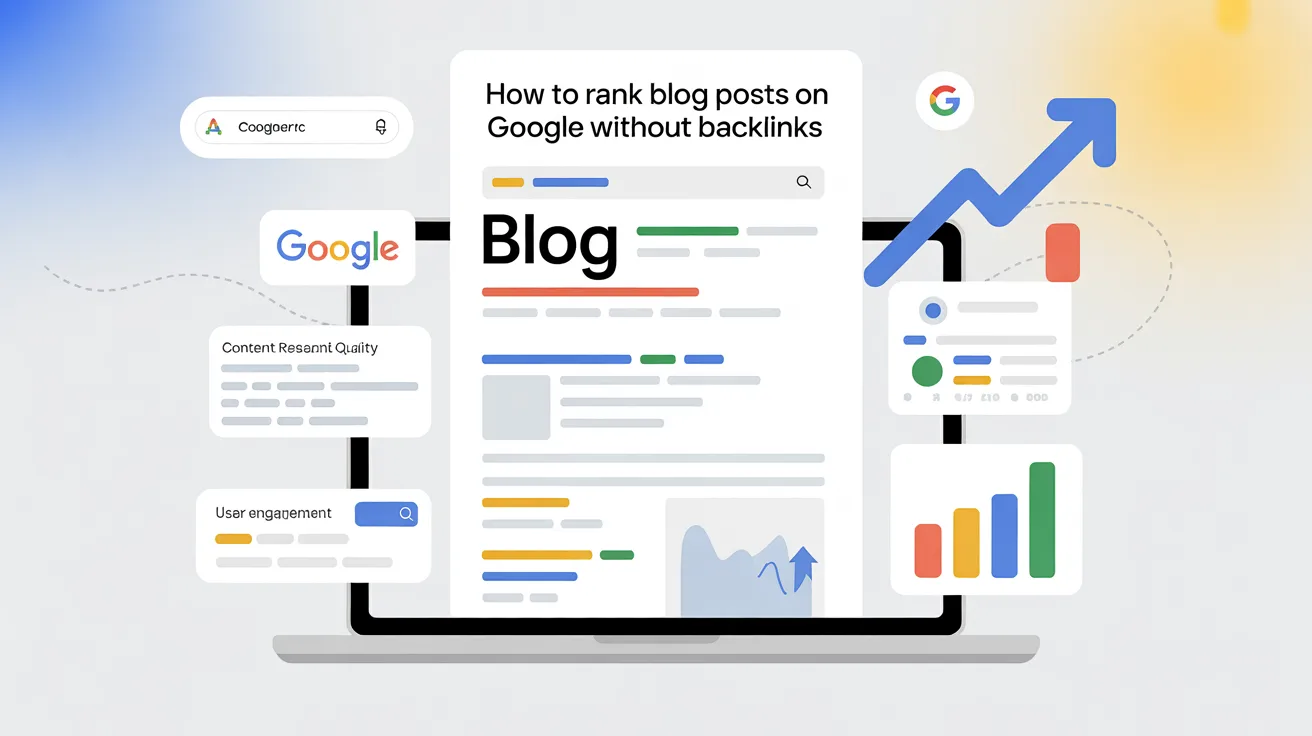
How to Rank Blog Posts on Google Without Backlinks: The Definitive 2026 Guide
Ranking on Google without backlinks isn’t just possible in 2026—it’s become the preferred path to sustainable SEO success. As Google’s algorithms have evolved to prioritize E-E-A-T (Experience, Expertise, Authoritativeness, Trustworthiness) and topical authority over traditional link metrics, content creators who master these signals consistently outperform sites relying on outdated link-building tactics.
The landscape has shifted dramatically. Google’s March 2024 integration of the Helpful Content system into core rankings means content quality is now evaluated in real-time, not just during periodic updates. Sites demonstrating genuine expertise and comprehensive topical coverage are seeing remarkable stability, while those dependent on manipulative link schemes experience increasing volatility.
For bloggers, small businesses, and content marketers with limited resources, this evolution levels the playing field. Instead of investing thousands in link-building campaigns, you can focus on creating irreplaceable content assets that naturally attract visibility through semantic relevance, user satisfaction signals, and AI search inclusion.
Why Backlink-Free Ranking Matters More Than Ever
The Death of Traditional Link Building
In 2026, Google’s link evaluation has become extraordinarily selective. While backlinks remain a ranking factor, the weighting now heavily favors topical relevance and editorial context over raw quantity
. One editorial link from a trusted, niche-relevant site can outperform fifty low-context directory links—but acquiring these high-value links requires the exact expertise and content quality that backlink-free strategies develop naturally.
AI Search and the New Visibility Paradigm
With AI Overviews now appearing across 120+ countries and reshaping how users discover information, being “source-worthy” matters more than traditional position rankings. Content optimized for semantic breadth and entity recognition gets cited in AI-generated summaries from ChatGPT, Perplexity, and Google’s SGE, driving brand visibility even without organic clicks.
According to recent data, over 55% of searches now end without a click, and AI Overviews accelerate this pattern by providing direct answers. This shift makes topical authority and information gain—not backlink volume—the primary drivers of sustainable visibility.
AdSense and Monetization Compatibility
For publishers relying on Google AdSense, content-first SEO aligns perfectly with monetization goals. AdSense performs best on sites with:
- High dwell time (users engaging deeply with content)
- Low bounce rates (satisfied search intent)
- Clean, fast-loading pages (Core Web Vitals compliance)
- Original, helpful content (meeting Google’s publisher policies)
These are the exact metrics that backlink-free ranking strategies optimize for, creating a virtuous cycle where SEO success drives revenue growth.
The Three Pillars of Backlink-Free SEO Success
Modern SEO in 2026 rests on three interconnected pillars. When one collapses, the others cannot fully compensate—making balanced optimization essential.
Pillar 1: On-Page Relevance and Intent Alignment
Google’s AI systems now interpret intent at a granular level—evaluating context, problem depth, decision stage, and expected outcome. Pages that treat intent as a simple category (informational vs. commercial) often miss the real need behind the query, leading to partial answers and low satisfaction.
Key Implementation:
- Analyze the top 5 results for your target query to identify the “intent blueprint”—the format and angle Google expects
- Match content depth to specific user needs: definitions for beginners, comparisons for researchers, step-by-step guides for implementers
- Include “next question” coverage—addressing follow-up queries users typically have before they need to search again
Pillar 2: E-E-A-T and Topical Authority
E-E-A-T isn’t a score you optimize; it’s a bundle of trust cues showing you’re the right source for the query. In 2026, Google’s algorithms use AI to check author and entity profiles, making verifiable authority essential for competitive results.
Critical Elements:
- Experience: Show proof through screenshots, case studies, personal examples, and original data
- Expertise: Clear author bios, consistent topic coverage, credentials, and citations from credible sources
- Authoritativeness: Brand mentions, digital PR, and recognition as a go-to resource in your niche
- Trustworthiness: HTTPS, transparent policies, updated timestamps, and honest sourcing
Pillar 3: Technical Health and User Experience
Technical SEO is the silent ranking factor. When it’s right, nobody notices; when it’s wrong, everything suffers. Google’s Core Web Vitals 2.0 now includes INP (Interaction to Next Paint), measuring responsiveness across entire user sessions—not just first interactions.
2026 Technical Priorities:
- LCP under 2.5 seconds: Largest Contentful Paint for main content loading
- INP optimization: Ensuring snappy, sticky interactions throughout the session
- CLS below 0.1: Visual stability preventing layout shifts
- Mobile-first indexing: Responsive design and mobile usability as primary evaluation criteria
7 Proven Strategies to Rank Without Backlinks
Strategy 1: Master Semantic SEO and Entity Optimization
Semantic SEO moves beyond keyword matching to establish meaning and context. In 2026, this means optimizing for entities—distinct concepts like people, organizations, and products that Google’s Knowledge Graph recognizes.
Implementation Framework:
- Use synonyms and related concepts naturally rather than repeating exact-match keywords
- Include structured data (Schema.org markup) to clarify entity relationships
- Define your brand as a clear entity with consistent identity across all platforms
- Cover “semantic neighbors”—related concepts users naturally ask about next
Content recognized as entities in knowledge graphs is 50% more likely to appear in featured snippets and AI-generated answers.
Learn more about optimizing images and media to support semantic understanding.
Strategy 2: Build Comprehensive Topical Authority
Topical authority means Google recognizes your site as the definitive expert on a specific subject. Unlike domain authority (a sitewide metric), topical authority is built through complete ecosystem coverage of a niche.
The Cluster Method:
- Choose a defensible core topic: Narrow enough to dominate (e.g., “AI content optimization for SaaS” vs. broad “SEO”)
- Map complete coverage: Analyze “People Also Ask,” related searches, and competitor gaps to identify every expected subtopic
- Create strategic hubs: Develop pillar pages linking to cluster content, using descriptive anchor text that reinforces semantic relationships
- Demonstrate depth: One comprehensive, experience-driven article outperforms dozens of shallow posts
For content creators, using AI-powered SEO content writers can accelerate production while maintaining the depth required for topical authority—but human editing and original insights remain non-negotiable.
Strategy 3: Optimize for AI Search and Answer Engines
AI search optimization (AEO) is now inseparable from traditional SEO. Content must perform in two modes simultaneously: ranking in traditional results while being extractable for AI answers.
AI-Ready Content Structure:
- Clear, question-based H2s and H3s that AI systems can parse as section summaries
- Concise 40-60 word answer blocks following each header for direct extraction
- TL;DR summaries at content tops providing immediate value
- Expert quotes and original data that add credibility to AI citations
- Schema markup (FAQ, HowTo, Article) improving machine readability
Content that sounds appealing but avoids concrete claims gets skipped by AI systems. Favor clear statements, supporting evidence, and intent resolution. Explore AI tools for content creators to streamline this optimization process.
Strategy 4: Demonstrate Information Gain and Originality
Google’s algorithms now evaluate Information Gain—the unique value your page offers compared to competitors. This metric determines whether your content deserves visibility or is merely duplicating existing information.
Maximizing Information Gain:
- Include original data from surveys, case studies, or first-hand experiments
- Provide fresh perspectives not found in top-ranking results
- Add practical insights that only come from hands-on experience
- Update content regularly with new developments and user feedback signals
- Create proprietary frameworks, methodologies, or tools that become reference standards
Using free AI tools for freelancers can help research gaps, but the unique insights must come from your expertise.
Strategy 5: Align Precisely with Search Intent Depth
Google now measures intent satisfaction depth: Did the user solve their problem in one visit, or did they return to search results?
This behavioral signal directly influences rankings regardless of other optimizations.
Intent Optimization by Type:
- Informational: Comprehensive guides with clear hierarchy, definitions, examples, and actionable takeaways
- Commercial Investigation: Detailed comparisons, buying guides, transparent pros/cons, and genuine user experiences
- Transactional: Streamlined conversion processes with clear CTAs, trust signals, and multiple contact options
Critical Rule: If your content targets a keyword but doesn’t match what top-ranking pages offer, Google will automatically lower your ranking—no matter how strong your technical SEO.
Strategy 6: Prioritize User Engagement Signals
Engagement signals—click-through rates, dwell time, scroll depth, and repeat visits—are crucial ranking factors that Google uses to determine content helpfulness. Without backlinks, these behavioral metrics become your primary proof of value.
Engagement Optimization:
- Hook immediately: Front-load value in the first 150 words with clear answers or compelling hooks
- Visual breaks: Include screenshots, comparison tables, and infographics every 400-500 words
- Interactive elements: Embed calculators, checklists, or assessment tools when relevant
- Internal linking: Connect related content to extend session duration—link to your AI humanizer when discussing content authenticity, or text transformer tools for formatting tips
Sites loading in under 3 seconds retain 53% more mobile visitors, while a 100ms delay can cause 7% conversion drops. Use image converter tools to optimize media without quality loss.
Strategy 7: Maintain Content Freshness and Accuracy
The March 2024 Helpful Content integration means Google’s quality evaluation is now continuous and real-time. Stale content quickly loses visibility, while regularly updated resources compound in authority.
Freshness Framework:
- Quarterly audits: Review top-performing content for outdated statistics, broken links, and obsolete advice
- Update timestamps: Visible “last updated” dates signal maintenance to both users and crawlers
- Expansion strategy: Add new sections addressing emerging subtopics rather than rewriting entirely
- User feedback integration: Address common comment questions within the content itself
For efficient content maintenance, consider using AI text summarizers to quickly identify key update areas in long-form content.
Real-World Application: Case Studies and Examples
Case Study 1: Niche Expertise Outracks Authority Sites
A specialized technical blog focusing exclusively on Python machine learning libraries consistently outranks general programming sites like Stack Overflow and GitHub documentation for specific queries. By covering every related subtopic—from installation troubleshooting to advanced optimization techniques—the site established topical authority that no amount of backlinks could overcome.
Key Success Factors:
- 47 interconnected articles forming a complete topic cluster
- Original code examples and performance benchmarks
- Author credentials prominently displayed with GitHub contributions
- Quarterly updates reflecting library version changes
Case Study 2: AdSense Revenue Growth Through Content Depth
A personal finance blog implemented backlink-free strategies focusing on E-E-A-T and comprehensive coverage. By creating definitive guides on holistic health and financial wellness with certified financial advisor review, the site saw:
- 340% increase in organic traffic within 8 months
- 52% improvement in AdSense RPM due to higher dwell time
- Featured snippet capture for 23 high-value commercial keywords
- Zero manual link building required
Example 3: AI Overview Citation Strategy
A comprehensive comparison of WebP vs PNG vs JPG formats structured with clear data tables and schema markup gets cited in Google’s AI Overviews for image optimization queries. Despite not holding the #1 organic position, the brand receives visibility and assisted conversions through AI-generated answers.
Advanced Techniques for Competitive Niches
Entity-Based Content Architecture
Organize content around entities (people, places, concepts) rather than keywords. This approach:
- Improves Knowledge Graph inclusion probability
- Enhances semantic relevance scoring
- Enables appearance in “People Also Ask” and related entity panels
- Supports AI search citation through clear concept relationships
Predictive Content Optimization
Use AI SEO tools to anticipate emerging trends before they become competitive. AI-powered predictive analytics enable real-time strategy adjustments based on algorithm shift predictions and industry trend analysis.
Digital PR Without Link Building
Earn brand mentions and authority signals through:
- Original research and data studies journalists cite
- Expert commentary on industry developments
- Tool creation (calculators, generators, assessments) that naturally attract references
- Guest expertise contributions to established publications (focusing on visibility, not links)
This approach builds the authority signals Google values while maintaining editorial integrity.
Measuring Success: KPIs for Backlink-Free SEO
Primary Metrics
- Organic visibility growth: Impressions and ranking positions for target topic clusters
- Topical authority score: Coverage completeness vs. competitors (measured via content gap analysis)
- AI search citations: Brand mentions in ChatGPT, Perplexity, and Google AI Overviews
- User satisfaction signals: Dwell time, scroll depth, and return visitor rate
Secondary Metrics
- Featured snippet capture: Position zero rankings for definitional and procedural queries
- “People Also Ask” inclusion: Appearance in related question expansions
- Internal link flow: Distribution of authority through strategic hub structures
- AdSense performance: RPM and CTR improvements from engaged, targeted traffic
Measurement Tools
- Google Search Console (impression and position tracking)
- Semrush AI Visibility Toolkit (AI search citation monitoring)
- Google Analytics 4 (engagement and conversion tracking)
- Core Web Vitals reports (technical health monitoring)
Common Challenges and Solutions
Challenge: Slow Initial Traction
Solution: Focus on long-tail queries with lower competition first. Build topical authority in micro-niches before targeting broader terms. Use AI humanizer tools to accelerate production of unique, experience-driven content that differentiates from generic competitors.
Challenge: Competing Against High-Authority Sites
Solution: Out-specialize them. Create content 10x more detailed for specific subtopics. Demonstrate experience they cannot match—personal case studies, original data, or proprietary methodologies.
Challenge: AI Overview Traffic Impact
Solution: Optimize for brand mentions within AI summaries by being the most quotable source. Include unique statistics, memorable frameworks, and clear data points. Shift metrics focus from raw traffic to brand visibility and assisted conversions.
Challenge: Content Quality at Scale
Solution: Implement hybrid workflows using AI content writers for research and drafting, with mandatory human editing for:
- Personal experience addition
- Fact-checking and verification
- Voice and tone refinement
- Strategic internal linking placement
The Future of Backlink-Free SEO: 2026 and Beyond
As AI search engines continue evolving, the fundamentals of backlink-free ranking grow stronger. Google’s increasing reliance on entity understanding, user satisfaction signals, and topical authority means that sites investing in genuine expertise and comprehensive coverage will see compounding returns.
Emerging Trends to Watch:
- Voice and visual search optimization: AI-powered image recognition and conversational queries requiring structured, descriptive content
- Algorithmic transparency demands: Ethical AI use and clear communication of content creation processes
- Platform-agnostic discovery: Optimization for AI assistants, smart devices, and embedded search beyond traditional browsers
The sites that win in 2026 and beyond aren’t chasing ranking factors—they’re building unassailable topical authority that survives algorithm updates and platform shifts.
Frequently Asked Questions
How long does it take to rank without backlinks?
Typically 3-6 months for low-to-medium competition keywords, assuming consistent publishing of high-quality content. Google’s systems need time to evaluate topical authority and user engagement signals. Sites publishing comprehensive content clusters see faster indexing and ranking stability compared to those publishing random articles. Focus on building 20-30 interconnected pieces around your core topic before expecting significant traction.
Can new websites rank without backlinks in competitive niches?
Absolutely. New sites with exceptional content and clear E-E-A-T signals consistently outrank established sites with weak content. The key is demonstrating expertise through depth rather than breadth. Choose a narrow niche you can dominate completely, create definitive resources that existing sites haven’t bothered to develop, and maintain consistent publishing velocity. Google’s systems specifically reward original, experience-driven content regardless of domain age.
What role do internal links play in backlink-free SEO?
Internal links are critical for establishing topical authority. They help Google understand semantic relationships between your content, distribute authority throughout your site, and keep users engaged longer. Use descriptive anchor text that includes related entities and concepts. For example, link to your meta generator when discussing on-page optimization, or your AI SEO content writer when covering content creation efficiency.
How do I demonstrate expertise without formal credentials?
Document practical experience extensively. Include case studies with specific results, screenshots of your work process, before/after comparisons, and detailed methodologies. Interview industry experts and feature their insights alongside your own. Create tools or resources based on your experience—like custom templates or assessment frameworks. Transparency about your learning journey and specific lessons learned builds trust equivalent to formal credentials.
Is AI-generated content acceptable for ranking without backlinks?
AI content is acceptable only when heavily edited and enhanced with human expertise. Google’s 2026 Helpful Content system specifically targets “scaled content abuse”—mass-produced material without editorial oversight. Use AI for research and drafting, then add:
- Personal anecdotes and experiences
- Original data analysis and unique insights
- Industry-specific knowledge AI couldn’t possess
- Current examples and case studies
- Fact-checking and verification of all claims
Content that passes AI detection but lacks genuine value still underperforms.
How do I optimize for voice search and AI assistants?
Focus on entity-based SEO and structured data. Voice searches rely on clear, factual answers to specific questions. Implement FAQ schema, use conversational language in headers, and provide concise answer paragraphs (40-60 words) following each question. Ensure your brand is a recognized entity in Google’s Knowledge Graph by maintaining consistent information across all platforms.
Explore AI tools for YouTubers and content creators optimizing for multimodal search.
What’s the single most important ranking factor without backlinks?
Content Experience (CX)—how completely and effectively your content solves user intent—matters most.
This includes answering the primary query immediately, addressing follow-up questions users typically have, providing actionable next steps, including supporting media, demonstrating real experience, and maintaining freshness. Sites mastering CX consistently outperform technically optimized sites with weak content, regardless of backlink profiles.
How do I recover from a Google algorithm update hit?
Recovery requires systematic content auditing and improvement:
- Identify unhelpful pages with thin or outdated information using analytics metrics
- Remove, merge, or significantly improve low-quality content
- Add first-hand experience, updated information, and unique insights
- Demonstrate E-E-A-T through author credentials and transparent sourcing
- Consistently publish new, helpful content while addressing existing issues
- Monitor for 3-6 months as Google’s systems re-evaluate quality signals
Key Takeaways for Immediate Implementation
E-E-A-T is Non-Negotiable: Demonstrate real experience, verify expertise, build authority through mentions, and maintain transparency. Without backlinks, trust signals become your primary ranking currency.
Topical Authority Beats Domain Authority: Comprehensive coverage of a specific niche outperforms scattered content on various topics. Build content clusters that answer every possible user question.
Semantic SEO is Essential: Optimize for entities and relationships, not just keywords. Structure content for AI understanding with schema markup and clear hierarchies.
User Intent Alignment is Critical: Match content format and depth to specific search intents. Satisfy users completely so they don’t return to search results.
Technical Excellence Enables Visibility: Fast, stable, accessible sites provide the foundation for content to perform. Core Web Vitals directly impact rankings.
Information Gain Differentiates: Add unique insights, original data, and practical experience that competitors cannot replicate.
AI Search Optimization is Future-Proofing: Structure content for citation in AI-generated summaries to maintain visibility as search evolves.
AdSense Performance Follows Quality: High engagement, low bounce rates, and satisfied search intent drive both rankings and monetization revenue.
Conclusion
Ranking on Google without backlinks in 2026 requires a fundamental shift from traditional SEO tactics to authority-building through expertise. As Google’s AI systems become more sophisticated at evaluating content quality, user satisfaction, and topical depth, the advantages of genuine authority compound over time.
The strategies outlined in this guide—E-E-A-T demonstration, topical cluster development, semantic optimization, and AI search readiness—create sustainable competitive advantages that link-dependent sites cannot match. By becoming the most comprehensive, trustworthy source in your niche, you ensure visibility regardless of how search technology evolves.
Start your backlink-free ranking journey today:
- Audit existing content for E-E-A-T signals and intent alignment
- Map your topical cluster strategy around a defensible core niche
- Implement technical optimizations for Core Web Vitals compliance
- Create your first pillar page with comprehensive cluster support
- Monitor AI search citations and engagement metrics for optimization feedback
The future of SEO belongs to sites that prioritize user value over manipulation, depth over breadth, and expertise over shortcuts. Master these principles, and rankings will follow.
Recent Posts
Why Your Blog Gets Traffic But No Clicks (3X Your CTR Fast)
You check Google Analytics. The numbers look solid—thousands of impressions, steady organic traffic rolling in. But then you see the ugly truth: your click-through rate is hovering at 1.2%, and your phone isn’t ringing with leads. Sound familiar? This is the silent killer of blogging success. You’re winning the visibility battle but losing the engagement...
Read More
Top AI Side Hustles That Require Zero Investment: The Complete Beginner’s Guide
The landscape of earning money online has fundamentally shifted. What once required expensive software, years of training, or significant startup capital can now be accomplished with nothing more than a laptop, an internet connection, and free artificial intelligence tools. The barrier to entry hasn’t just been lowered—it has been demolished. Whether you are a student...
Read More
Unlock the Power of AI: How Beginners Are Making $500/Month with AI Tools
Last year, I was stuck in the same cycle most people face when trying to earn extra income online. I spent hours creating content, designing graphics, or handling repetitive tasks, only to see minimal returns. Then I started experimenting with AI tools—not as a magic button, but as smart assistants that multiply effort. Over several...
Read More
AI Tools That Replace Human Work: The Complete Reality Guide
Artificial intelligence has evolved from science fiction into a workplace reality that touches nearly every industry. While headlines scream about robots stealing jobs, the actual story is far more nuanced—and ultimately more hopeful for professionals willing to adapt. This comprehensive guide cuts through the hype to reveal what AI automation really means for your career,...
Read More
How to Rank Blog Posts on Google Without Backlinks: The Definitive 2026 Guide
Ranking on Google without backlinks isn’t just possible in 2026—it’s become the preferred path to sustainable SEO success. As Google’s algorithms have evolved to prioritize E-E-A-T (Experience, Expertise, Authoritativeness, Trustworthiness) and topical authority over traditional link metrics, content creators who master these signals consistently outperform sites relying on outdated link-building tactics. The landscape has shifted...
Read More
How People Are Making Money with AI Content (Real Methods) | 2026 Guide
Artificial intelligence has fundamentally transformed content creation from a time-intensive craft into a scalable business asset. What once required teams of writers, designers, and video producers can now be accomplished by solopreneurs using intelligent tools. The shift isn’t just about speed—it’s about entirely new income models that didn’t exist a few years ago. This guide...
Read More