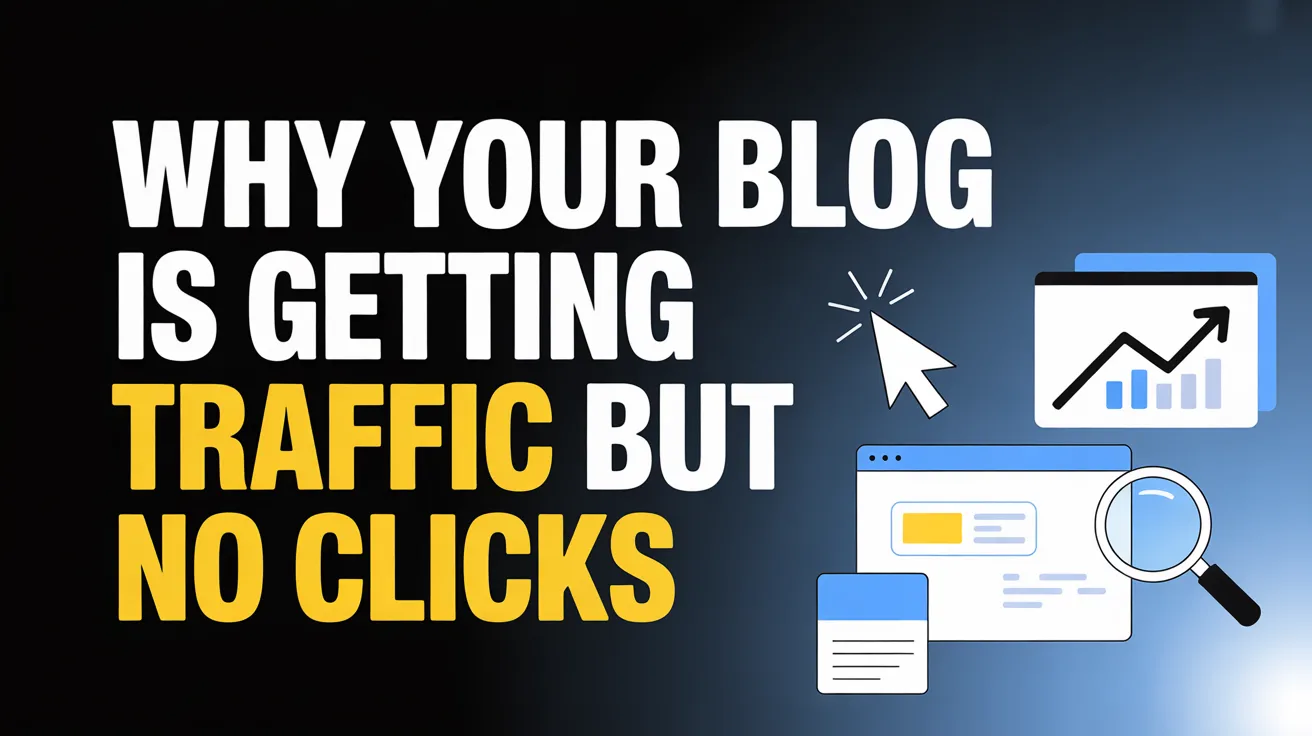
Why Your Blog Gets Traffic But No Clicks (3X Your CTR Fast)
You check Google Analytics. The numbers look solid—thousands of impressions, steady organic traffic rolling in. But then you see the ugly truth: your click-through rate is hovering at 1.2%, and your phone isn’t ringing with leads. Sound familiar?
This is the silent killer of blogging success. You’re winning the visibility battle but losing the engagement war. The good news? This problem is fixable, and the solutions are more straightforward than you think.
In this guide, I’ll show you exactly why your blog attracts eyeballs but fails to earn clicks—and the specific tactics to triple your CTR using 2026’s latest optimization strategies.
The Brutal Math Behind Low CTR
Here’s a reality check from Forbes: the average organic CTR across all industries sits around 2.6%. But that number is misleading. If you’re ranking in position #1, you should be capturing 39.8% of clicks. Position #2? That drops to 18.7%. By position #5, you’re fighting for scraps at 7.4%.
If your CTR is below these benchmarks, you’re hemorrhaging potential revenue every single day. A site getting 10,000 monthly impressions with a 1% CTR generates 100 clicks. Boost that to 3%, and you’re looking at 300 clicks—without writing a single new post or building additional backlinks.
The traffic is already there. You just need to capture it.
Diagnosis: Why People See Your Blog But Don’t Click
Your Titles Are Invisible in the SERP
Most bloggers write titles for readers, not for search psychology. You have 600 pixels of space in Google’s results—roughly 60 characters—to convince someone to abandon their current trajectory and choose your content.
The data from Google Search Central is clear: title tags containing exact match keywords see 5.8% higher CTR than those using variations. But here’s the nuance—keyword stuffing kills performance. You need emotional triggers, specificity, and benefit-driven language.
Compare these two titles:
- “Best Productivity Tools for Freelancers”
- “7 Productivity Tools That Saved Me 15 Hours Last Week (Freelancer Tested)”
The second title promises specific value, includes a number (proven to boost CTR by up to 36%), and suggests personal experience. That’s the difference between a scroll-past and a click.
Meta Descriptions That Fail to Sell
Your meta description is ad copy, not a summary. Yet most bloggers treat it like an afterthought, letting Google auto-generate snippets that miss the point entirely.
Google rewrites meta descriptions 62.78% of the time, but that doesn’t excuse lazy optimization. When Google does use your description, it needs to function as a compelling reason to click. Think of it as your elevator pitch in 160 characters or less.
The fix? Front-load your primary keyword in the first 120 characters, include a clear benefit, and end with an open loop or specific promise. “Learn 5 strategies” is weak. “Discover the 5-minute daily habit that doubled my freelance income” creates curiosity.
Search Intent Mismatch
This is where most blogs die quietly. You might rank for “AI side hustles,” but if your content focuses on theoretical possibilities while searchers want step-by-step execution guides, they’ll bounce immediately.
Search intent comes in four flavors: informational (learning), navigational (finding a specific site), commercial (comparing options), and transactional (ready to buy). Your content must match the dominant intent for your target keywords, or your CTR will suffer regardless of ranking position.
For example, someone searching for top AI tools for making money online wants actionable recommendations, not a history of artificial intelligence. Give them what they came for immediately, or watch your CTR flatline.
SERP Features Are Stealing Your Thunder
Position #1 doesn’t guarantee clicks anymore. Featured snippets, People Also Ask boxes, video carousels, and AI Overviews are click magnets that dominate the visual hierarchy of search results.
If your content isn’t optimized for these features, you’re invisible even when you rank well. Structured data markup, clear heading hierarchies, and concise “snippet-worthy” answers in your first 100 words can win you that prime real estate.
Technical Fixes That Instantly Boost CTR
Optimize for Position Zero
Featured snippets appear above the traditional #1 result, capturing 35.1% of all clicks according to Backlinko. To win them, structure your content with:
- 40-60 word definitions at the start of sections
- Numbered or bulleted lists for processes
- Comparison tables for “vs” queries
- Direct answers followed by deeper explanation
When you provide clear, structured information, Google rewards you with maximum visibility—and your CTR jumps accordingly.
Leverage Schema Markup
Structured data isn’t just for rich results; it’s a CTR multiplier. FAQ schema can expand your listing vertically in the SERP, pushing competitors below the fold. How-to schema signals actionable content. Review schema builds trust with star ratings.
Implementation is straightforward using JSON-LD. Add it to your header or use a plugin, but don’t skip it. Sites with proper schema markup consistently outperform competitors in click-through rates because they look more authoritative in the results page.
Speed and Mobile Optimization
In 2026, mobile-first indexing is absolute. If your blog loads slowly on phones, Google notices—and users bounce before they even see your content. Core Web Vitals directly impact rankings, but they also affect CTR indirectly. Slow sites get buried, and buried sites don’t get clicked.
Compress images, eliminate render-blocking resources, and use a CDN. Your mobile experience should be frictionless. Remember: 58.67% of global traffic comes from mobile devices. Ignore this at your CTR’s peril.
Content-Level CTR Optimization
Hook Readers in the First 15 Seconds
Once someone clicks, you have roughly 15 seconds to convince them to stay. Your introduction must validate their search intent immediately and promise specific value.
Weak opening: “In this article, we’ll discuss various strategies for improving productivity.” Strong opening: “I wasted 18 months on low-CTR content before discovering these 5 fixes. Here’s exactly how I tripled my click-through rate in 30 days.”
The second version establishes credibility, creates curiosity, and promises actionable results. That’s what keeps readers engaged—and what signals quality to Google.
Use AI-Powered Content Tools Strategically
Modern AI tools can analyze top-performing content in your niche and identify the emotional triggers, formatting patterns, and keyword placements that drive clicks. But don’t rely on automation alone.
Tools like AI-powered SEO content writers can help you craft optimized meta descriptions and title variations for A/B testing. They can analyze competitor snippets and suggest improvements based on actual SERP performance data.
The key is using AI to enhance human judgment, not replace it. Your unique voice and experience are what ultimately differentiate your content and build the trust that drives repeat clicks.
Internal Linking for CTR and Retention
Strategic internal linking serves two masters: it helps Google understand your site structure, and it keeps readers engaged longer. Both impact your overall CTR performance.
When someone clicks through to your site from search, your internal links should guide them to related high-value content. If they land on a post about making money with AI content, link to your guide on AI side hustles that actually make money to deepen their engagement.
Use descriptive anchor text that sets clear expectations. “Click here” tells Google and users nothing. “Learn the 3-step validation process for AI side hustles” creates curiosity and improves relevance signals.
Advanced 2026 Strategies
Optimize for AI Overviews
Google’s AI Overviews now appear in 15% of search results, and that number is growing. When your content gets cited in these overviews, you gain visibility even without traditional ranking—but you also risk losing clicks if the overview answers the query completely.
The strategy? Create content that answers the initial question but requires deeper exploration. Be comprehensive enough to earn the AI citation, but structured to drive readers to your site for implementation details, tools, and templates.
Video and Visual Integration
Video content in search results can increase CTR by 41% compared to text-only listings. Even if you’re primarily a written content site, embedding relevant videos and optimizing them with transcripts and schema can win you video carousel placements.
For bloggers in the AI and tech space, this is particularly relevant. If you’re writing about AI tools for YouTubers, include video demonstrations of those tools in action. The multimedia approach captures multiple SERP features and appeals to different learning preferences.
Personalization and Dynamic Content
Modern CMS platforms allow for dynamic title tags and meta descriptions based on user location, device, or referral source. While this requires technical setup, the CTR improvements can be substantial.
A user searching for free AI tools every freelancer should use from a mobile device in New York might see: “7 Free AI Tools NYC Freelancers Are Using to Cut Work Hours.” That specificity outperforms generic titles every time.
The Measurement Framework
You can’t improve what you don’t measure. Set up Google Search Console to track your average CTR by query, page, and position. Look for these specific patterns:
- High impressions, low CTR at positions 1-3: Title and meta description problem
- High impressions, low CTR at positions 4-10: Ranking potential, but need better snippet optimization
- High CTR, low conversions: Content-relevance mismatch or poor on-page experience
Aim for steady improvement. A 0.5% CTR increase across your top 20 pages can double your organic traffic without any new content creation.
Frequently Asked Questions
How long does it take to see CTR improvements after optimization?
Typically, you’ll see initial data within 7-14 days in Google Search Console, but meaningful trends require 4-6 weeks. Google needs time to recrawl your pages and test new titles and descriptions in the SERP. Don’t panic if you see fluctuations initially—Google often tests multiple variations of your snippets before settling on consistent performance. Track your metrics weekly, but judge success monthly. If you’ve made comprehensive changes across your site, expect a 3-month window to see the full impact as rankings adjust to reflect improved user engagement signals.
What’s the ideal CTR benchmark for my industry?
While the overall average sits at 2.6%, your specific benchmark depends on your niche and ranking position. Industries like technology and B2B software often see higher CTRs (3-4%) due to engaged, research-heavy audiences. Lifestyle and entertainment blogs might average 1.5-2%. The key is beating your own historical performance and the current average for your specific ranking positions. If you’re in position #1 and getting less than 25% CTR, you have a serious optimization opportunity regardless of industry averages.
Can I test different titles without hurting my SEO?
Absolutely, and you should. Use A/B testing tools or manually rotate title variations every 2-3 weeks, measuring CTR changes in Google Search Console. Just avoid changing your URL slug, as that disrupts ranking equity. Keep a spreadsheet of your tests—document the old title, new title, date changed, and CTR before/after. Over time, you’ll develop an intuition for what resonates with your specific audience. Remember that Google sometimes rewrites titles anyway, so your official title tag is a suggestion, not a guarantee.
How do I optimize for voice search CTR?
Voice search optimization focuses on conversational, question-based queries. Structure content around “who, what, when, where, why, and how” questions. Use natural language in your titles—”How do I fix low CTR on my blog?” rather than “Blog CTR Optimization Strategies.” Include concise 30-word answers early in your content, then expand with detail. Voice assistants often pull from featured snippets, so winning position zero becomes even more critical. Also, optimize for local intent if relevant, as voice searches are frequently location-based.
Should I prioritize CTR or rankings?
This is a false choice—you need both, but prioritize based on your current situation. If you’re ranking on page 2 (positions 11-20), focus on ranking improvements first through content quality and backlinks. CTR optimization matters little if no one sees your listing. However, if you’re already on page 1 (positions 1-10) and not getting clicks, CTR optimization becomes your highest-ROI activity. A page at position #5 with optimized titles can outperform position #3 with generic snippets. Audit your Search Console data to identify which pages have the biggest gap between ranking potential and actual click performance.
Conclusion: Your CTR Transformation Starts Now
Low CTR isn’t a traffic problem—it’s a conversion problem on the search results page itself. You’ve already done the hard work of creating content and earning visibility. Now it’s time to capture the clicks you deserve.
Start with your highest-traffic, lowest-CTR pages. Rewrite those titles with emotional triggers and specific benefits. Craft meta descriptions that function as compelling ad copy. Structure your content to win featured snippets and optimize for the search intent behind every query.
The difference between a 1% CTR and a 3% CTR isn’t magic—it’s methodical optimization based on how real humans make clicking decisions. Implement these strategies systematically, measure your results, and watch your organic traffic actually convert into engaged readers, leads, and revenue.
Ready to put these strategies into action? Check out our comprehensive guide on how to rank blog posts to ensure your optimized content reaches page one, then explore passive income with AI tools to monetize that increased traffic effectively. For developers looking to build their own optimization tools, see our recommendations for the best AI tool for developers.
Your blog deserves better than vanity metrics. Fix your CTR, and turn that existing traffic into real business growth.
Recent Posts
Why Your Blog Gets Traffic But No Clicks (3X Your CTR Fast)
You check Google Analytics. The numbers look solid—thousands of impressions, steady organic traffic rolling in. But then you see the ugly truth: your click-through rate is hovering at 1.2%, and your phone isn’t ringing with leads. Sound familiar? This is the silent killer of blogging success. You’re winning the visibility battle but losing the engagement...
Read More
Top AI Side Hustles That Require Zero Investment: The Complete Beginner’s Guide
The landscape of earning money online has fundamentally shifted. What once required expensive software, years of training, or significant startup capital can now be accomplished with nothing more than a laptop, an internet connection, and free artificial intelligence tools. The barrier to entry hasn’t just been lowered—it has been demolished. Whether you are a student...
Read More
Unlock the Power of AI: How Beginners Are Making $500/Month with AI Tools
Last year, I was stuck in the same cycle most people face when trying to earn extra income online. I spent hours creating content, designing graphics, or handling repetitive tasks, only to see minimal returns. Then I started experimenting with AI tools—not as a magic button, but as smart assistants that multiply effort. Over several...
Read More
AI Tools That Replace Human Work: The Complete Reality Guide
Artificial intelligence has evolved from science fiction into a workplace reality that touches nearly every industry. While headlines scream about robots stealing jobs, the actual story is far more nuanced—and ultimately more hopeful for professionals willing to adapt. This comprehensive guide cuts through the hype to reveal what AI automation really means for your career,...
Read More
How to Rank Blog Posts on Google Without Backlinks: The Definitive 2026 Guide
Ranking on Google without backlinks isn’t just possible in 2026—it’s become the preferred path to sustainable SEO success. As Google’s algorithms have evolved to prioritize E-E-A-T (Experience, Expertise, Authoritativeness, Trustworthiness) and topical authority over traditional link metrics, content creators who master these signals consistently outperform sites relying on outdated link-building tactics. The landscape has shifted...
Read More
How People Are Making Money with AI Content (Real Methods) | 2026 Guide
Artificial intelligence has fundamentally transformed content creation from a time-intensive craft into a scalable business asset. What once required teams of writers, designers, and video producers can now be accomplished by solopreneurs using intelligent tools. The shift isn’t just about speed—it’s about entirely new income models that didn’t exist a few years ago. This guide...
Read More